
Deload Week: When You Need One and How to Do It
Learn when to take a deload week, how to do it correctly, and why it can help you build more muscle, strength, and long-term progress.
WORKOUT PROGRAMS
Sam Waz
7/24/20264 min read
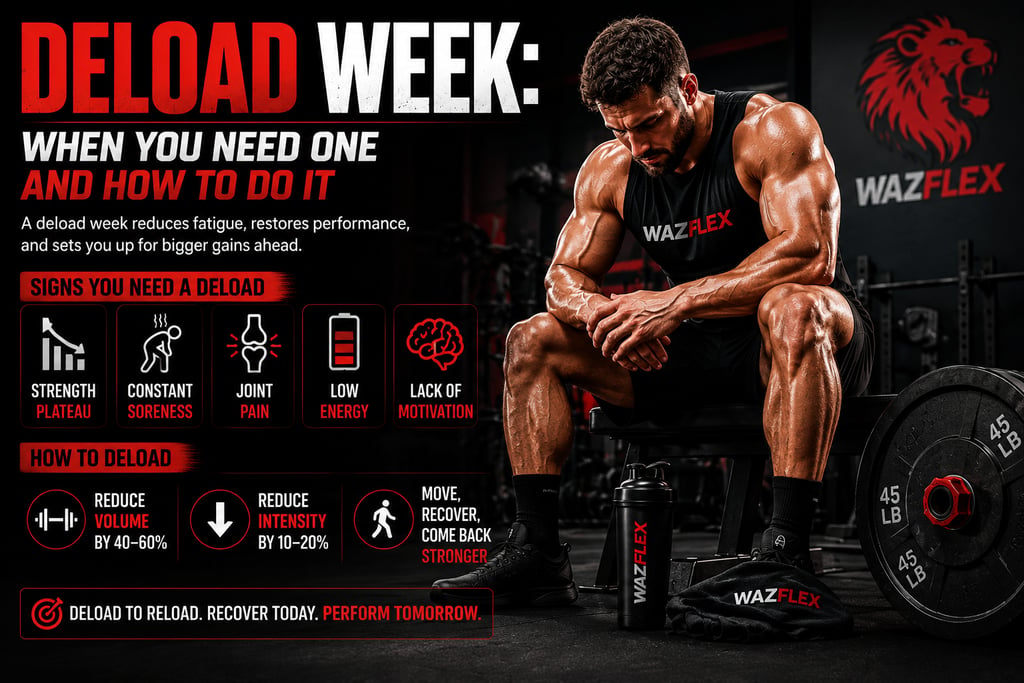
Deload Week: When You Need One and How to Do It
Tired of feeling beat up in the gym? Your lifts are stalling. Your joints ache. Motivation is disappearing. Before you assume you've hit your genetic limit, the answer might be surprisingly simple: take a deload week.
Contrary to popular belief, taking a step back doesn't make you weaker. When programmed correctly, a deload allows your body to recover from accumulated fatigue so you can come back stronger, healthier, and more motivated.
Elite powerlifters, bodybuilders, Olympic lifters, and professional athletes all use deloads. The smartest lifters understand that progress isn't made by training hard every single day—it's made by balancing stress and recovery.
What Is a Deload Week?
A deload week is a planned reduction in training stress. This usually lasts 5–7 days, during which you reduce your training volume, intensity, or both while continuing to perform your normal exercises.
Think of it as pressing the reset button without stopping training completely.
The goal is to reduce:
Muscle fatigue
Joint stress
Nervous system fatigue
Mental burnout
While maintaining:
Movement patterns
Technique
Muscle mass
Training habits
Why Deload Weeks Work
Every workout creates two things:
Fitness adaptations
Fatigue
Initially, both rise together.
Over time, however, fatigue accumulates faster than fitness.
Eventually your performance drops—not because you've stopped improving, but because you're carrying too much fatigue.
A well-timed deload removes fatigue while preserving your fitness, allowing your true strength and muscle gains to show. This principle is discussed in Eric Helms' Muscle & Strength Pyramid: Training under the fitness-fatigue model and deload programming.
Signs You Need a Deload
You don't have to wait until you're injured.
Watch for these warning signs:
Your Strength Is Falling
You're lifting less weight despite eating and sleeping well.
Constant Muscle Soreness
DOMS lasts several days instead of one or two.
Joint Pain
Knees, elbows, shoulders or lower back begin hurting consistently.
Poor Recovery
You feel exhausted before workouts even begin.
Loss of Motivation
The thought of training feels like work instead of excitement.
Poor Sleep
Ironically, excessive training often reduces sleep quality.
Elevated Resting Heart Rate
Your recovery capacity is decreasing.
Plateau for Several Weeks
No progress despite consistent effort.
Who Needs Deloads?
Beginners
Probably not very often.
Beginners usually recover quickly because they:
Lift lighter weights
Perform less total volume
Haven't accumulated years of fatigue
Many beginners can train continuously for months before requiring a structured deload.
Intermediate Lifters
Usually benefit every:
6–10 weeks
Depending on:
Training volume
Intensity
Sleep
Stress
Nutrition
Advanced Lifters
Advanced athletes create far more fatigue because they lift heavier loads and perform greater training volumes.
Many benefit from a planned deload every:
4–8 weeks
How to Deload Properly
There are several effective methods.
Option 1: Reduce Volume (Recommended)
This is the preferred method for most lifters.
Keep:
Same exercises
Same weights
Reduce:
Total sets by 40–60%
Example:
Instead of:
Bench Press
5 × 8
Do:
2–3 × 8
This maintains strength while dramatically reducing fatigue.
Option 2: Reduce Weight
Keep your normal number of sets.
Reduce the load by:
10–20%
This works well for strength athletes nearing maximal loads.
Option 3: Reduce Both
For people who feel completely drained:
Reduce:
Weight
Sets
This creates the greatest recovery.
Option 4: Active Recovery Week
Instead of heavy lifting:
Walking
Swimming
Cycling
Mobility work
Stretching
Yoga
This approach works particularly well after competitions or very demanding training blocks.
What Should You Avoid During a Deload?
Don't turn your deload into another hard training week.
Avoid:
Training to failure
PR attempts
High-volume supersets
Marathon cardio sessions
Excessive HIIT
Remember:
The goal is recovery—not proving you're tough.
Should You Eat Less During a Deload?
Not much.
Many people mistakenly slash calories.
Your body is still repairing tissue.
Maintain:
Protein intake
Micronutrients
Hydration
If you're bulking, keep calories close to normal.
If you're cutting, continue your calorie deficit unless recovery has become a major issue.
Will I Lose Muscle During a Deload?
No.
Muscle loss takes far longer than one week.
Research consistently shows that muscle size and strength are maintained during short periods of reduced training, especially when protein intake remains adequate and some resistance training is maintained.
In many cases you'll actually look fuller after a deload because inflammation decreases and recovery improves.
Sample Deload Week
ExerciseNormal WeekDeload WeekSquat5×5 @ 100 kg2×5 @ 90–100 kgBench Press4×82×8Deadlift4×52×5Rows4×102×10Shoulder Press4×82×8Isolation Work3–4 sets1–2 sets
Should Deloads Be Planned or Automatic?
Both approaches work.
Planned Deload
Ideal if:
Following structured programs
Powerlifting
Bodybuilding
Peaking for competition
Auto-Regulated Deload
Take one when recovery markers decline.
This flexible approach is also supported in evidence-based programming, where training is adjusted based on fatigue and performance rather than rigid calendars.
Common Deload Mistakes
❌ Taking an entire week off unnecessarily
❌ Training to failure anyway
❌ Trying to "make up" missed work
❌ Doing excessive cardio
❌ Reducing protein intake
❌ Returning with the exact same workload without assessing recovery
The Bottom Line
A deload isn't a sign of weakness—it's a tool for long-term progress.
If you're constantly sore, mentally exhausted, or stuck at the same weights, your body may not need more effort. It may need more recovery.
The best athletes aren't the ones who train the hardest every day.
They're the ones who know when to push and when to recover.
Recover well, and you'll come back stronger.
Frequently Asked Questions
How often should I take a deload?
Most intermediate lifters benefit every 6–10 weeks, while advanced lifters often deload every 4–8 weeks depending on training stress.
Should I stop lifting completely?
Usually no. Keeping your regular exercises while reducing training stress helps maintain strength and technique.
Can I do cardio during a deload?
Yes. Light walking, cycling, swimming, or mobility work are great options. Avoid high-intensity interval training or exhaustive endurance sessions.
Will I lose strength after a week off?
No. Most people maintain strength and often feel stronger after a deload because accumulated fatigue has dissipated.
References
Helms ER, Morgan A, Valdez A. The Muscle & Strength Pyramid: Training (2nd Edition). 2018.
Grgic J, et al. Effects of Resistance Training Frequency on Measures of Muscle Hypertrophy: A Systematic Review and Meta-analysis. Sports Medicine. 2018.
Schoenfeld BJ. Science and Development of Muscle Hypertrophy. 2nd Edition. Human Kinetics, 2020.
Zourdos MC, et al. Novel Resistance Training–Specific Rating of Perceived Exertion Scale Measuring Repetitions in Reserve. Journal of Strength and Conditioning Research. 2016.
Ready to train smarter, not just harder? Follow WazFlex for evidence-based training guides, recovery strategies, and practical advice to help you build muscle, gain strength, and stay injury-free.
WAZFLEX FITNESS
CONTACT
info@wazflex.com
© 2026. All rights reserved.
PRIVACY POLICY
Train Smart. Build Strong. Stay Real.


The science of strength. The discipline of results.