
How Close to Failure Should You Train?
How close to failure should you train for maximum muscle growth? Learn the science of RIR, training to failure, fatigue, and better gains.
WORKOUT PROGRAMS
Sam Waz
7/15/202611 min read
How Close to Failure Should You Train? The Answer Most Lifters Get Wrong
You finish a brutal set.
Your muscles are burning. Your breathing is heavy. You rack the weight and stare at yourself in the mirror.
Was that enough?
Could you have done another rep?
Should you have kept going until the weight physically refused to move?
Or did you just create a mountain of fatigue for almost no additional muscle growth?
This is one of the most important questions in hypertrophy training:
How close to failure should you actually train?
For years, gym culture gave us two completely opposite answers.
One camp said:
“If you’re not training to failure, you’re not training hard enough.”
The other said:
“Never train to failure. It destroys recovery.”
Both are oversimplifications.
The science—and decades of real-world coaching—point toward a much more useful answer:
Most of your muscle-building sets should probably finish somewhere around 1–3 reps from failure.
Not easy.
Not comfortable.
But not necessarily all-out failure, either.
The best lifters understand something most beginners eventually learn the hard way:
Your goal is not to win one set.
Your goal is to build more muscle over months and years.
And those are not always the same thing.
The One Question That Changes How You Train
Forget the number of reps written in your program for a moment.
Instead, ask:
How many good reps did I genuinely have left?
That question may tell you more about the difficulty of your set than the rep number alone.
Imagine two people perform 10 repetitions of the same exercise.
The first person stops at 10 but could have performed another eight reps.
The second person stops at 10 and could have performed only one more.
On paper, both did:
1 set × 10 reps.
Physiologically, those sets were not equally demanding.
That is why experienced lifters increasingly think about training in terms of proximity to failure.
And the simplest way to measure it is RIR.
What Is RIR?
RIR means Reps in Reserve.
It estimates how many additional repetitions you could have completed before reaching failure.
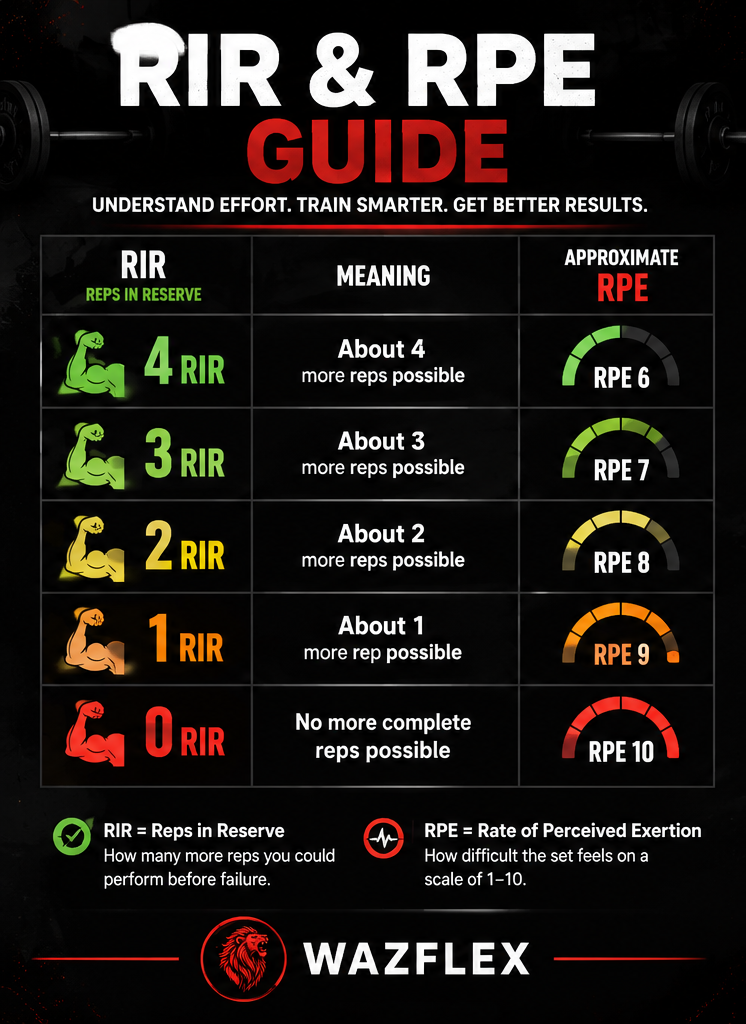
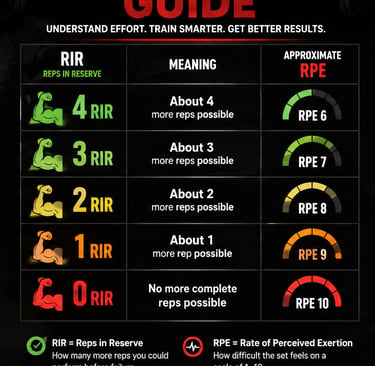
RIR and RPE Guide
4 RIR: About 4 more reps possible — RPE 6
3 RIR: About 3 more reps possible — RPE 7
2 RIR: About 2 more reps possible — RPE 8
1 RIR: About 1 more rep possible — RPE 9
0 RIR: No more complete reps possible — RPE 10
RIR = Reps in Reserve — how many more reps you could perform before failure.
RPE = Rate of Perceived Exertion — how difficult the set feels on a scale of 1–10.
If you perform 10 reps and genuinely believe you could have completed 12, you stopped at approximately 2 RIR.
If you complete 10 reps and an 11th is impossible, you have reached approximately 0 RIR.
This sounds simple.
There is only one problem.
Most people are worse at estimating failure than they think.
We will come back to that.
First, we need to answer the big question.
So, How Close to Failure Should You Train?
For most people training primarily to build muscle:
Train most working sets around 1–3 RIR.
That means finishing the majority of your hard sets with approximately one to three clean repetitions left in the tank.
This is not a magic number.
Muscle does not have an internal counter that says:
“Three reps from failure? No growth. Two reps from failure? Activate hypertrophy.”
The body does not work like that.
Think of proximity to failure as a continuum.
As a set becomes increasingly difficult, the stimulus generally increases—but so does fatigue.
That creates the central problem of intelligent hypertrophy training:
How do you create enough stimulus to grow without creating so much fatigue that your next sets, next exercises, and next workouts suffer?
That is the game.
Not suffering.
Not soreness.
Not crawling out of the gym.
Stimulus versus fatigue.
Training to Failure Is Not Magic
There is something psychologically satisfying about failure.
You know the set is over.
There is no ambiguity.
The weight simply will not move.
That certainty makes failure seductive.
If you stop with two reps left, you might wonder:
Could I have done more?
At failure, you know.
But certainty does not automatically make something optimal.
Training to failure can absolutely build muscle.
The question is not:
Does failure work?
It does.
The better question is:
Do you need to reach failure on every set to maximize your results?
For most lifters, the answer is no.
And there is a simple reason.
Failure Has a Cost
Imagine your true maximum with a certain weight on the bench press is eight repetitions.
You go all-out on your first set:
Set 1: 8 reps — failure
Set 2: 6 reps
Set 3: 5 reps
Total: 19 reps
Now imagine you stop one rep short on the first set:
Set 1: 7 reps
Set 2: 7 reps
Set 3: 7 reps
Total: 21 reps
The first approach looked harder.
The second may have produced more high-quality work.
That is one of the biggest mistakes in bodybuilding.
Winning the First Set. Losing the Workout.
A lifter destroys the first exercise.
Every set is a grinder.
Every rep is a war.
By exercise three, performance has collapsed.
Loads drop.
Repetitions disappear.
Technique deteriorates.
The workout felt incredible.
But feeling destroyed is not a reliable measure of muscle growth.
The hardest possible workout is not automatically the most productive workout.
The Real Goal: Maximum Stimulus, Recoverable Fatigue
Think about your training like an investment.
Every hard set has a potential return: the stimulus that contributes to adaptation.
But every set also has a cost: fatigue.
Early in a hard set, the fatigue cost may be relatively manageable.
As you approach failure, each additional repetition becomes increasingly difficult.
The final rep may take several seconds.
Technique may begin to change.
Your nervous system, cardiovascular system, supporting musculature, and target muscle are all fighting to complete the repetition.
You may gain additional stimulus.
But you also pay a larger fatigue bill.
That does not make the final rep useless.
It means the final rep needs to be worth the cost.
This is why smart programming does not ask:
“Can I train harder?”
It asks:
“Will training harder here improve my total results?”
That is a much better question.
Not All Failure Is the Same
The phrase “training to failure” hides an important distinction.
Technical Failure
Technical failure occurs when you can no longer perform another repetition with acceptable technique.
You might still be capable of moving the weight—but only by:
swinging
bouncing
shortening the range of motion
changing your body position
using excessive momentum
turning the exercise into something else entirely
For many exercises, technical failure is the more useful stopping point.
Muscular Failure
Muscular failure occurs when you genuinely cannot complete another repetition despite maximal effort.
The weight stops.
The rep fails.
But here is the key:
Failing a lateral raise and failing a heavy back squat are not remotely the same event.
That brings us to one of the most important practical rules in this entire article.
The More Dangerous and Fatiguing the Exercise, the Less You Need Failure
Consider these two scenarios.
Scenario A: Cable Lateral Raise
You attempt another rep.
The weight moves halfway.
Your delt is finished.
You lower the handle.
Set over.
Scenario B: Heavy Barbell Back Squat
You descend with a heavy bar across your back.
You reach the bottom.
You try to stand.
Nothing happens.
Those are both technically “failure.”
But the consequences are very different.
This is why proximity to failure should depend on the exercise.
Heavy Compound Exercises: Usually Stop Short
Exercises such as:
back squats
front squats
deadlifts
Romanian deadlifts
heavy bench presses
overhead presses
heavy free-weight rows
usually do not need to be taken to absolute failure.
A practical target for many working sets is approximately:
1–3 RIR
And on particularly heavy or technically demanding work:
2–4 RIR can be completely appropriate.
You can still train brutally hard.
You simply stop before the rep becomes an uncontrolled survival attempt.
The goal is not to see whether gravity can defeat you.
Gravity always wins eventually.
Isolation Exercises Are Different
Now consider:
lateral raises
biceps curls
triceps pushdowns
leg extensions
leg curls
calf raises
cable flyes
These exercises generally create less whole-body fatigue.
The consequences of reaching failure are usually lower.
That makes them better candidates for 0–1 RIR and occasional true failure.
For example:
Lateral Raises
Set 1: 2 RIR
Set 2: 1 RIR
Set 3: 0–1 RIR
That is very different from taking every set of heavy squats, deadlifts, presses, rows, curls, and raises to complete failure.
One is strategic intensity.
The other is often just unmanaged fatigue.
A useful rule is:
The safer and more stable the exercise, the more aggressively you can approach failure.
The training source similarly suggests that failure can be used intelligently on isolation exercises or on the final set of the final exercise for a muscle group.
Here’s Where Most Lifters Get RIR Wrong
A beginner finishes a set.
The coach asks:
“How many reps did you have left?”
The lifter says:
“Maybe one.”
The coach says:
“Keep going.”
Five reps later, the lifter is still moving the weight.
This happens constantly.
Many people confuse:
“That was uncomfortable”
with:
“I was close to failure.”
They are not the same thing.
High-repetition sets can burn.
Your heart rate climbs.
Your breathing becomes uncomfortable.
Your muscles fill with metabolites.
Your brain starts negotiating with you.
But discomfort can arrive long before muscular failure.
That is especially important with lighter loads.
The training literature summarized in The Muscle and Strength Training Pyramid notes that higher-repetition training can build muscle when effort is sufficiently high, but very high-repetition work may create substantial discomfort and global fatigue, making proximity to true muscular failure harder to judge.
The Calibration Test
Here is one of the best ways to learn what failure actually feels like.
Choose a relatively safe exercise:
machine curl
leg extension
triceps pushdown
machine chest press
lateral raise
Perform a set.
Stop when you believe you have 2 RIR.
Then, occasionally and under appropriate conditions, continue the set.
If you get:
2 more reps: your estimate was excellent.
3–4 more reps: you underestimated yourself slightly.
7 more reps: what you called “2 RIR” was nowhere near 2 RIR.
You do not need to do this every workout.
You are calibrating your internal effort gauge.
The better you become at estimating RIR, the more useful RIR-based programming becomes. The training source specifically recommends experience, video review, coaching feedback, and appropriately controlled exposure to failure as ways to improve RIR accuracy.
Does Rep Range Change How Close You Should Train to Failure?
Yes.
This is where the conversation becomes more nuanced.
Heavy Sets
Imagine lifting a weight for five repetitions when you could perform seven.
You are at approximately 2 RIR.
Even though you did not reach failure, the load was still heavy.
Now imagine performing 20 repetitions with a weight you could actually lift 40 times.
You may feel a burn.
But you are nowhere near your true limit.
A Useful Practical Framework
Rep Range and Proximity to Failure
3–6 Reps: Often 2–4 RIR
6–15 Reps: Often 1–3 RIR
15–30+ Reps: Usually train closer to failure
RIR = Reps in Reserve — the number of additional reps you could perform before reaching failure.
These are not laws.
But the general principle matters:
The lighter the load, the more important it becomes to train sufficiently close to failure.
Research summarized in the uploaded training source indicates that both lower- and higher-load resistance training can produce hypertrophy when effort is high enough, although extremely light loading may be less efficient and create substantial discomfort before adequate local muscular stimulus is achieved.
Should Beginners Train to Failure?
Usually, not often.
Beginners have something advanced lifters would pay good money to get back:
They can grow from relatively modest training stimuli.
A beginner does not need advanced intensity techniques.
They need:
consistent training
good technique
progressive overload
adequate volume
sufficient protein
sleep
patience
And perhaps most importantly:
They need to learn how to train hard without training recklessly.
A useful starting point is:
Approximately 2–4 RIR on most working sets.
As technique improves and the lifter becomes better at judging effort, selected sets can be pushed closer to failure.
The goal is not to protect beginners from hard work.
The goal is to teach them what productive hard work actually looks like.
Should Advanced Lifters Train Closer to Failure?
Often—but more intelligently, not more recklessly.
Advanced lifters face a different problem.
The stronger and more developed you become, the harder it can be to continue creating a meaningful training stimulus.
An advanced lifter may therefore use proximity to failure more strategically across a training block.
For example:
Week 1: 3 RIR
Week 2: 2–3 RIR
Week 3: 2 RIR
Week 4: 1–2 RIR
Week 5: 0–1 RIR on selected exercises
Week 6: Deload
This creates progression without requiring every workout to become a death match.
During a deload, failure training generally defeats the purpose. The goal is to reduce accumulated fatigue and prepare for productive training ahead.
The “Effective Reps” Idea: Useful, but Don’t Turn It Into Dogma
You may have heard that only the final five repetitions before failure stimulate muscle growth.
This idea is often called the effective reps model.
It is useful as a mental model.
But do not interpret it as a literal biological law.
Your muscles do not count:
“Rep 8: useless.”
“Rep 9: useless.”
“Rep 10: congratulations, hypertrophy activated.”
The value of the concept is simpler:
As a set becomes sufficiently challenging, more motor units and muscle fibers must contribute to maintaining force.
The mistake is turning a useful model into internet dogma.
Muscle growth is influenced by:
mechanical tension
training volume
effort
exercise selection
progression
recovery
nutrition
individual response
There is no single magical rep.
When Should You Actually Train to Failure?
Failure is most useful when it has a reason.
Consider using it when:
performing a relatively safe isolation exercise
performing a stable machine exercise
completing the final set of an exercise
completing the final exercise for a muscle group
calibrating your RIR accuracy
performing a planned AMRAP test
using a carefully programmed intensity technique
Avoid making it your default when:
performing technically demanding heavy compounds
training without appropriate safety equipment
technique is deteriorating
fatigue is already high
performance is declining across sessions
you are in a deload
recovery is compromised
The principle is simple:
Use failure. Don’t let failure use you.
A Better Way to Program Training Intensity
Here is a practical starting framework for hypertrophy-focused training:
Practical RIR Guide
Heavy Squats & Deadlifts: 2–4 RIR
Heavy Free-Weight Compound Exercises: 1–3 RIR
Stable Machine Exercises: 1–2 RIR
Isolation Exercises: 0–2 RIR
Final Isolation Set: 0–1 RIR (optional)
Deload Training: 3+ RIR
RIR = Reps in Reserve — the number of additional reps you could perform before reaching failure.
Again, this is a framework.
Not a commandment.
Your ideal proximity to failure depends on:
your training age
exercise selection
rep range
weekly volume
training frequency
recovery capacity
injury history
current training phase
strength versus hypertrophy goals
But if you have been randomly taking every exercise to failure ,or stopping every set the moment it becomes uncomfortable this framework is a much better place to start.
The Mistake That Keeps Lifters Small
There are two ways to train badly.
Mistake #1: Never Training Hard Enough
Every set ends comfortably.
The weight never meaningfully progresses.
The lifter says:
“I don’t want to overtrain.”
But the muscles are barely being challenged.
Mistake #2: Turning Every Workout Into a Test of Survival
Every set reaches failure.
Forced reps.
Drop sets.
Partials.
Grinding.
More volume.
More intensity.
More fatigue.
The lifter says:
“You have to shock the muscle.”
Meanwhile, performance stagnates.
Joints hurt.
Recovery collapses.
Both lifters are missing the same principle.
Muscle growth requires sufficient stimulus—and the ability to recover from that stimulus.
Too little stimulus?
You stagnate.
Too much fatigue?
You also stagnate.
The best training lives between those extremes.
The WazFlex Rule: Earn the Right to Train to Failure
Here is the simplest way to remember everything in this article:
Most sets: Get close.
Some sets: Go all the way.
No sets: Lose control.
Train hard enough that the final repetitions demand focus.
Stop most compound sets before technique breaks down.
Push safe isolation exercises harder when it makes sense.
Track your performance.
Recover.
Then come back and do slightly more over time.
Because the purpose of today's workout is not simply to survive today's workout.
It is to make tomorrow's body stronger than today's.
Final Answer: How Close to Failure Should You Train?
For most people trying to build muscle:
Train most working sets approximately 1–3 reps from failure.
Use 0–1 RIR more selectively, particularly on safer isolation and machine exercises.
Stay further from failure on heavy, technically demanding compound movements when the fatigue or safety cost is high.
Beginners can often start around 2–4 RIR while learning technique and developing an accurate sense of effort.
And remember:
Failure is not the goal.
Progress is.
The strongest training programs do not ask you to prove how much pain you can tolerate.
They give your muscles a reason to adapt—and your body enough recovery to actually do it.
Build Muscle With Intelligence, Not Guesswork
WazFlex is built around one principle:
Cut through the fitness noise. Keep what works.
No bro-science commandments.
No fake shortcuts.
No workouts designed purely to leave you destroyed for social media.
Just practical, evidence-based training you can use to build a stronger, leaner, more capable body.
Train close enough to failure to force adaptation. Recover well enough to do it again. Progress long enough for the results to become impossible to ignore.
Disclaimer: Training recommendations should be individualized based on experience, health status, injury history, exercise selection, and recovery capacity. Stop any exercise that causes sharp or unusual pain and seek appropriate medical or rehabilitation advice when necessary.
Scientific References
Helms ER, Morgan A, Valdez A. The Muscle and Strength Training Pyramid: Training. 2nd ed. The source discusses proximity to failure, RIR/RPE, fatigue management, load selection, and the strategic use of failure training.
Zourdos MC, et al. Novel resistance training-specific rating of perceived exertion scale measuring repetitions in reserve. Journal of Strength and Conditioning Research. 2016;30(1):267–275.
Morán-Navarro R, et al. Time course of recovery following resistance training leading or not to failure. European Journal of Applied Physiology. 2017;117(12):2387–2399.
Davies T, et al. Effect of training leading to repetition failure on muscular strength: a systematic review and meta-analysis. Sports Medicine. 2016.
Schoenfeld BJ, et al. Strength and hypertrophy adaptations between low- vs. high-load resistance training: a systematic review and meta-analysis. Journal of Strength and Conditioning Research. 2017;31(12):3508–3523.
WAZFLEX FITNESS
CONTACT
info@wazflex.com
© 2026. All rights reserved.
PRIVACY POLICY
Train Smart. Build Strong. Stay Real.


The science of strength. The discipline of results.