
How Many Sets Per Muscle Per Week to Build Muscle?
How many sets do you really need to build muscle? Discover the science of training volume, junk sets, recovery and why more isn’t always better.
WORKOUT PROGRAMS
Sam Waz
7/14/202611 min read
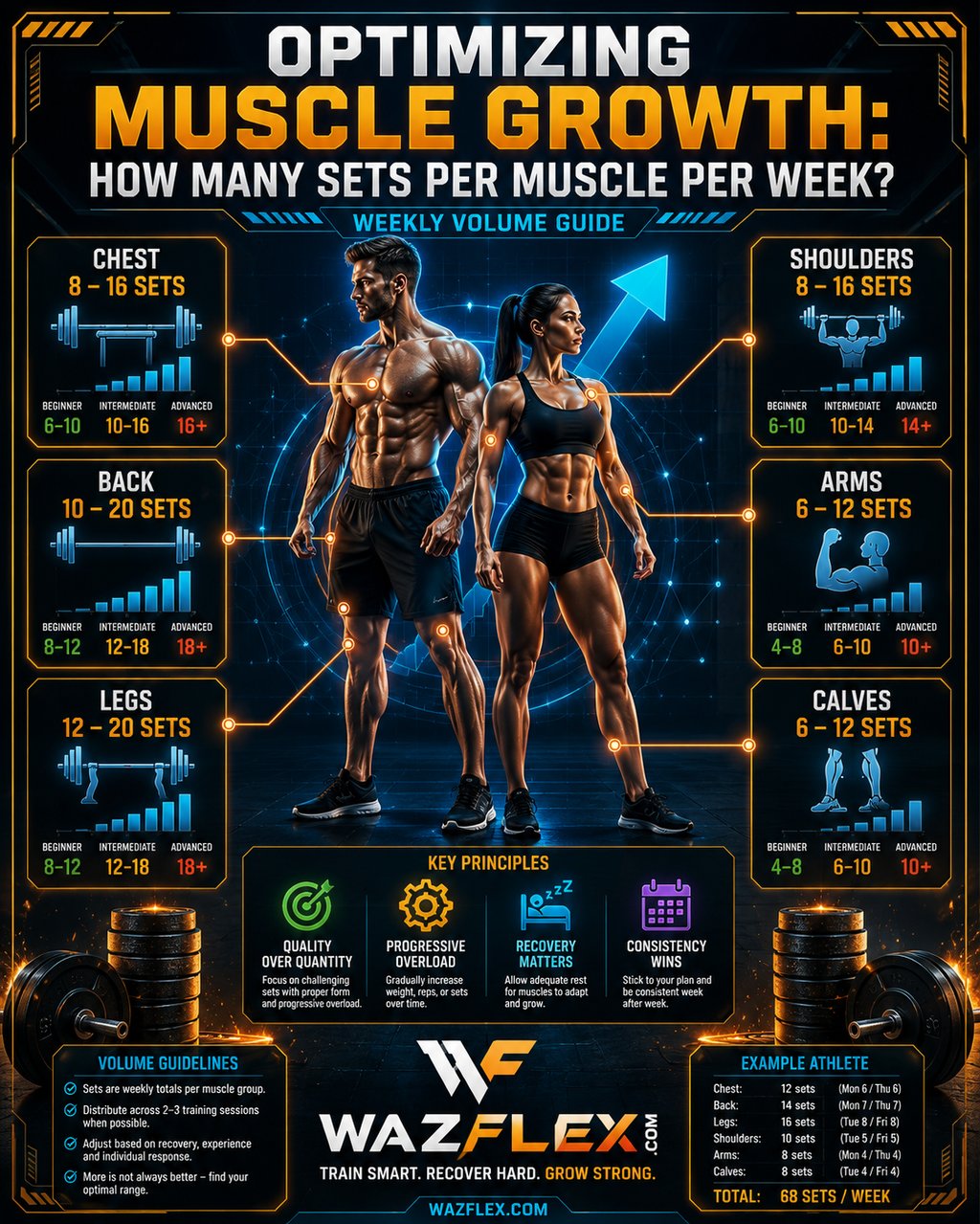
How Many Sets Per Muscle Per Week Do You Actually Need to Build Muscle?
There is a man in almost every gym who deserves his own documentary.
He arrives with a shaker bottle large enough to hydrate a small village.
He trains chest for two hours.
Bench press.
Incline press.
Decline press.
Dumbbell press.
Machine press.
Cable flyes.
Another type of cable fly because apparently the first cable fly did not understand the assignment.
Then push-ups.
Then drop sets.
Then a burnout set.
Then possibly another chest exercise he saw on Instagram while resting between the previous 17 chest exercises.
He leaves the gym unable to put on his own T-shirt.
He is exhausted.
He is destroyed.
He is incredibly proud of himself.
Six months later?
His chest looks exactly the same.
Welcome to one of the biggest misunderstandings in muscle building:
More work does not automatically mean more muscle.
If it did, the biggest person in every gym would simply be the person who stayed there the longest.
That is not how the body works.
Muscle growth is not a competition to see who can perform the most exercises, accumulate the most sets or leave the gym in the greatest amount of pain.
The goal is far more precise:
Do enough high-quality work to force your body to adapt—without doing so much that fatigue begins to sabotage the adaptation you are trying to create.
So how many sets per muscle per week do you actually need?
Ten?
Twenty?
Thirty?
The answer is not as satisfying as a magical number.
But it is far more useful.
First, Understand This: Your Body Cannot Count Sets
Your training log can.
Your fitness app can.
Your trainer can.
Your body cannot.
Your body does not know that you wrote:
CHEST — 20 SETS
in your notes app.
It only experiences what you actually did.
And that creates a problem.
Because not all sets are equal.
Imagine two people.
The first performs 10 challenging sets with excellent technique, appropriate loads, controlled repetitions and measurable progression.
The second performs 20 sets.
But half are too easy.
Several are performed with poor technique.
The final exercises are completed while exhausted.
The target muscle is barely doing the work.
And most of the session is spent chasing a pump.
Who did more?
On paper?
The second person.
In reality?
That question is far more complicated.
This is why blindly counting sets can become misleading.
A warm-up set is a set.
A brutal working set is also a set.
But they are obviously not the same thing.
Your muscles do not respond to numbers written in a notebook.
They respond to stimulus.
So, How Many Sets Per Muscle Per Week Should You Do?
Here is the simple answer most people came for:
Around 8–12 challenging sets per muscle group per week is a sensible starting point for many lifters.
Read that sentence again.
Starting point.
Not a law.
Not a commandment.
Not a magical hypertrophy code discovered on an ancient stone tablet underneath Gold’s Gym.
A starting point.
Research generally supports a dose-response relationship between resistance-training volume and muscle growth: increasing productive training volume can increase hypertrophy.
But only up to a point.
That final sentence is where many people stop listening.
They hear:
More volume can produce more muscle growth.
And immediately conclude:
Then I should do as much as physically possible.
No.
Water is essential for life.
That does not mean drinking 40 litres today will make you immortal.
The relationship between training volume and muscle growth is not infinitely linear.
At first, adding productive sets may improve the stimulus.
Then the returns begin to diminish.
Eventually, you may reach a point where additional work creates more fatigue than useful adaptation.
The Most Important Word in This Article Is Not “Volume”
It is:
Productive
Because there is a massive difference between training volume and productive training volume.
You can perform 30 sets for your chest.
That does not mean you performed 30 sets worth of useful muscle-building work.
Some of those sets may be excellent.
Some may be mediocre.
Some may exist only because you refused to go home.
This is where we need to talk about one of the most important and most abused terms in modern bodybuilding:
Junk Volume
Junk volume is the work you perform that adds fatigue, time and recovery demands without providing enough additional benefit to justify the cost.
Imagine this chest workout:
4 hard sets of bench press.
4 hard sets of incline dumbbell press.
3 challenging sets of cable flyes.
Your chest has already performed a substantial amount of work.
Then something happens.
You look at the clock.
You still have 45 minutes.
So naturally, you decide your chest has offended you personally.
You add:
4 sets of machine presses.
4 more sets of flyes.
100 push-ups.
Three drop sets.
A burnout circuit.
And perhaps some exercise where you stand upside down holding two cables because an influencer with suspiciously large shoulders said it targets the “inner upper chest.”
At some point, you are no longer increasing the quality of the workout.
You are collecting fatigue.
And fatigue is not a trophy.
Stop Judging Your Workout by How Destroyed You Feel
This may upset some people.
A great workout does not need to leave you unable to walk.
You do not need to vomit.
You do not need to crawl out of the gym.
You do not need to wake up three days later and discover that sitting on the toilet has become a mobility challenge.
Soreness can happen.
Fatigue can happen.
Hard training should feel hard.
But none of those things are the primary goal.
The goal is:
Adaptation.
You are not training to prove how much punishment you can survive.
You are training to become:
Stronger.
More muscular.
More capable.
If your workout consistently destroys your ability to perform well in your next workout, that is not automatically hardcore.
Sometimes it is simply poor programming wearing a stringer vest.
Your 20 Sets May Be Worse Than Someone Else’s 10
Let us return to our two lifters.
Lifter A
Performs 10 weekly sets for his back.
Every set is:
Technically sound
Appropriately loaded
Challenging
Controlled
Recorded
Progressed over time
Lifter B
Performs 25 weekly sets.
But:
Half the sets are too easy
Technique deteriorates as fatigue rises
Exercises change every week
Recovery is poor
Performance declines
There is no progression plan
Who is training better?
The person doing more?
Not necessarily.
This is the trap.
People often measure the seriousness of a workout by its length.
Three hours?
Hardcore.
Seven exercises?
Hardcore.
Thirty sets?
Hardcore.
But muscle does not grow because you impressed yourself with the duration of your workout.
Ten excellent sets can outperform a mountain of meaningless repetitions.
Quality does not make volume irrelevant.
It makes volume worth doing.
But How Hard Should a Set Actually Be?
This is where another extreme appears.
One group performs endless easy sets.
The other believes every set must end with a near-death experience.
Neither approach is particularly intelligent.
You do not need to reach absolute muscular failure on every set to build muscle.
But if every set ends while you could comfortably perform another eight, nine or ten repetitions, your “high-volume program” may simply be a large collection of warm-ups.
A productive hypertrophy set should generally be challenging enough to provide a meaningful stimulus.
How close you train to failure can depend on:
The exercise
Your experience
The load
The training phase
Fatigue
Safety
Taking a machine curl to failure is not the same as taking a heavy barbell squat to catastrophic failure.
Context matters.
The objective is not:
Fail every set.
The objective is:
Make your working sets matter.
The Beginner Doing 25 Sets Probably Does Not Need 25 Sets
Beginners often make one fascinating mistake.
They copy the training of people who have been lifting for 15 years.
A beginner watches an advanced bodybuilder perform:
Six exercises.
Four sets each.
Intensity techniques.
Drop sets.
Partial repetitions.
And thinks:
That must be what I need.
Probably not.
A beginner is in one of the most responsive stages of their entire training life.
The stimulus is new.
Strength can increase rapidly.
Technique is still developing.
The body has not yet adapted to years of resistance training.
You probably do not need a three-hour arm workout.
You need to learn how to:
Squat.
Press.
Pull.
Hinge.
Control a weight.
Train hard.
Recover.
Progress.
That may sound less exciting than the “SHOCK YOUR BICEPS WITH THIS 47-SET ARM DESTROYER” workout.
But it works.
Start with enough.
Then earn the need for more.
Advanced Lifters May Need More,But “More” Is Not the Same as “Everything”
As training experience increases, progress generally becomes harder to achieve.
The body adapts.
The easy gains slow down.
The stimulus that once produced rapid results may eventually become insufficient.
This is where some experienced lifters may benefit from increasing volume.
But advanced training is not simply:
Beginner program + 100 more sets.
Advanced lifters often need better management of:
Training volume
Intensity
Exercise selection
Frequency
Fatigue
Recovery
Periodization
The more advanced you become, the more valuable precision becomes.
Adding volume should be a decision.
Not an emotional reaction to a bad workout.
Compound Exercises Are Quietly Adding More Volume Than You Think
This is where counting sets becomes messy.
You perform bench presses.
Did you train your chest?
Obviously.
Did you train your triceps?
Yes.
Did you train your front deltoids?
Also yes.
Now imagine your program contains:
Bench press.
Incline dumbbell press.
Overhead press.
Dips.
Then you add 20 direct sets for your triceps because a chart online told you that every muscle needs 20 sets.
Your triceps would like to file a complaint.
Compound exercises create overlap.
The same applies to:
Rows and biceps
Pull-ups and biceps
Pressing and triceps
Squats and glutes
Deadlift variations and the posterior chain
This does not mean you need a PhD in mathematics to calculate whether one bench press set equals 0.73 triceps sets.
Do not turn your workout into a tax return.
Just understand this:
Your muscles do not train in isolation because your spreadsheet has separate columns.
Your total program matters.
Should You Do All Your Weekly Sets in One Workout?
Suppose you want to perform 14 weekly sets for your chest.
You have two options.
Option A
Monday:
14 sets.
Option B
Monday:
7 sets.
Thursday:
7 sets.
Both programs contain 14 weekly sets.
But they may not produce the same quality of training.
Why?
Because fatigue accumulates within a session.
Your first hard set may be excellent.
Your fifth may still be good.
By your fourteenth consecutive chest set, you may simply be negotiating with gravity.
Splitting weekly volume across multiple sessions can allow you to perform more of your work while relatively fresh.
That is one reason training a muscle around twice per week is a practical strategy for many people.
Not because Monday and Thursday contain magical hypertrophy energy.
But because distributing volume can help maintain performance and training quality.
Frequency is not just about how often you train.
It is also about how intelligently you distribute the work.
How Do You Know If You Need More Sets?
Here is where people make a surprisingly simple mistake.
Their program is working.
They are getting stronger.
Their repetitions are increasing.
Their measurements are improving.
Their physique is changing.
Then they see someone online doing twice as much volume.
So they change everything.
Why?
If your program is producing results, the first thing you should consider doing is:
Keep doing it.
Do not fix what is not broken.
If you are:
Getting stronger
Adding repetitions
Improving technique
Recovering well
Building muscle
Then your current training volume may already be doing its job.
More volume is not a reward for being ambitious.
Add volume when there is a reason to add volume.
If progress genuinely stalls—and your nutrition, sleep, technique, effort and consistency are in place—then increasing training volume may be worth testing.
Notice the word:
Testing.
Do not jump from 10 sets to 30 because you had one disappointing Monday.
Add a small amount.
Perhaps two to four additional weekly sets for the muscle you are trying to improve.
Then watch what happens.
Did performance improve?
Did growth resume?
Did recovery remain good?
Or did you simply become more tired?
Your results should guide your program.
Not your ego.
Signs You May Be Doing Too Much Volume
Your body usually sends signals.
The problem is that some lifters interpret every warning sign as evidence that they are “training hard.”
Persistent soreness?
Hardcore.
Declining strength?
Need to push harder.
Joint pain?
No pain, no gain.
Constant fatigue?
Must be working.
No.
Persistent problems deserve attention.
You may be doing more volume than you can currently recover from if you repeatedly experience:
Declining training performance
Persistent soreness
Poor recovery between sessions
Joint irritation
Constant fatigue
Reduced motivation
Difficulty progressing
Worsening technique
One bad workout means almost nothing.
A repeated pattern means something.
Sometimes the answer to a plateau is adding another set.
Sometimes the smartest thing you can do is remove five useless ones.
Stop Searching for the Perfect Number
People love exact numbers.
Tell me the perfect number of sets.
Tell me the perfect number of repetitions.
Tell me the perfect rest period.
Tell me the perfect exercise.
Then I can stop thinking.
Unfortunately, your body did not read the same fitness infographic.
The amount of training volume you need depends on:
Your training experience
Your exercise selection
How hard you train
Your recovery
Your sleep
Your nutrition
Your genetics
Your training frequency
The muscle being trained
Your current goals
And here is another complication:
You may need different amounts of volume for different muscles.
Your legs may grow easily.
Your shoulders may not.
Your back may recover quickly.
Your hamstrings may remain sore for days.
There is no reason to assume every muscle in your body requires exactly the same amount of work.
So stop asking:
“What is the perfect number of sets?”
Ask a better question:
“What Is the Smallest Amount of Productive Training I Need to Keep Making Progress?”
That question changes everything.
Because now you are no longer trying to win the workout.
You are trying to win the adaptation.
The WazFlex Starting Point
If all of this sounds complicated, it does not need to be.
Start simple.
For each major muscle group:
Begin around 8–12 challenging weekly sets.
Where practical, distribute that work across approximately two sessions.
Choose exercises you can perform well.
Keep important movements in your program long enough to improve them.
Track:
Weight used
Repetitions performed
Technique
Recovery
Performance
Then watch what happens.
If you are growing and progressing:
Do not touch anything.
Keep going.
If progress stalls, first examine:
Nutrition
Sleep
Training effort
Exercise execution
Consistency
Recovery
Only then ask whether you need more volume.
If you do?
Add a little.
Measure.
Adjust.
Repeat.
The goal is not to discover the maximum amount of training you can survive.
The goal is to discover the amount of training that allows you to progress.
The Gym Does Not Give Out Awards for the Most Sets
Nobody is standing at the exit with a trophy.
Congratulations. You performed 37 sets of chest today.
Your muscles are not impressed.
The body does not reward drama.
It rewards adaptation.
A great program is not necessarily the one that looks most brutal on paper.
It is the one that you can perform consistently, recover from and progress over time.
That may mean 8 sets.
It may mean 12.
It may eventually mean 16 or more for a particular muscle.
But the number is not the goal.
Progress is the goal.
Final WazFlex Message
So, how many sets per muscle per week do you need to build muscle?
For many people:
Around 8–12 challenging weekly sets per muscle group is a sensible place to start.
Some people will grow with less.
Some will eventually benefit from more.
But remember:
More sets do not automatically mean more muscle.
The goal is not to accumulate the most volume.
The goal is to accumulate the most productive, recoverable volume.
Train hard enough to give your body a reason to adapt.
Recover well enough to allow that adaptation to happen.
Track your results.
Then adjust.
Because the person doing 25 sets is not automatically training harder than the person doing 10.
Sometimes -
They are just taking longer to achieve less.
Train with purpose.
Measure what matters.
And never confuse more work with better work.
Consistency is the real flex.
Scientific References
Schoenfeld BJ, Ogborn D, Krieger JW. Dose-response relationship between weekly resistance training volume and increases in muscle mass: A systematic review and meta-analysis. Journal of Sports Sciences. 2017.
Schoenfeld BJ et al. Resistance training volume enhances muscle hypertrophy but not strength in trained men. Medicine & Science in Sports & Exercise. 2019.
Krieger JW. Single vs. multiple sets of resistance exercise for muscle hypertrophy: A meta-analysis. Journal of Strength and Conditioning Research. 2010.
Baz-Valle E, Fontes-Villalba M, Santos-Concejero J. Total number of sets as a training volume quantification method for muscle hypertrophy: A systematic review. Journal of Strength and Conditioning Research. 2021.
Helms E, Morgan A, Valdez A. The Muscle and Strength Training Pyramid: Training. 2nd ed. The framework covers training volume, intensity, frequency, progression, exercise overlap and fatigue management.
Disclaimer: Training volume should be individualized. If you have an injury, medical condition, or persistent unexplained pain or fatigue, consult an appropriately qualified healthcare or exercise professional.
WAZFLEX FITNESS
CONTACT
info@wazflex.com
© 2026. All rights reserved.
PRIVACY POLICY
Train Smart. Build Strong. Stay Real.


The science of strength. The discipline of results.