
Progressive Overload: 12 Ways to Build Muscle When You Can't Add More Weight
Stuck lifting the same weights? Discover 12 science-backed ways to use progressive overload and keep building muscle—even when the bar won't get any heavier.
WORKOUT PROGRAMS
Sam Waz
7/21/20266 min read
Progressive Overload: What to Do When You Can't Add More Weight
Walk into any gym, and you'll hear the same advice.
"Just add more weight."
It's repeated so often that people think progressive overload is nothing more than loading another plate onto the bar.
For beginners, that advice works.
For a while.
But then reality arrives.
You bench 80 kg.
Next week...
Still 80 kg.
A month later...
Still 80 kg.
Suddenly you begin questioning yourself.
"Have I reached my genetic limit?"
"Am I doing something wrong?"
"Why am I not getting stronger anymore?"
The truth is much simpler.
You haven't run out of progress.
You've only run out of one way to measure it.
The biggest mistake in modern bodybuilding is believing that progressive overload means adding weight every workout.
If that were true, someone who started bench pressing 40 kg would eventually be lifting 1,000 kg.
Obviously, that's impossible.
Strength doesn't increase forever.
But progress absolutely can.
The world's strongest athletes don't keep improving because they magically add weight every session.
They improve because they understand something most gym-goers never learn:
Progressive overload is about asking your body to do more than it has adapted to—not necessarily lifting more weight every week.
Once you understand that, your training changes forever.
What Is Progressive Overload?
Every workout sends your body a message.
"This wasn't easy."
Your body has two choices.
Remain exactly the same.
Or adapt.
It chooses adaptation.
Muscles become stronger.
Bones become denser.
The nervous system becomes more efficient.
Movement becomes smoother.
But here's the catch.
Once your body adapts...
The exact same workout is no longer enough.
Imagine carrying grocery bags.
The first day they feel heavy.
After carrying them every day for six months...
They're effortless.
The bags didn't get lighter.
You became stronger.
The gym works exactly the same way.
Your body only changes when you continually give it a reason to change.
That is progressive overload.
The Biggest Myth in Fitness
One of the worst pieces of advice in bodybuilding is:
"You have to add weight every workout."
No.
You don't.
In fact, trying to force heavier weights every session is one of the fastest ways to destroy your technique, increase injury risk, and stall your progress.
Elite athletes don't ask:
"Can I lift more today?"
They ask:
"Can I perform better today?"
That is a completely different mindset.
Performance can improve in dozens of ways.
Weight is only one of them.
The 12 Ways to Use Progressive Overload
1. Add More Weight
Let's begin with the obvious one.
If you performed:
80 kg × 8 reps
Last week...
And this week you perform:
82.5 kg × 8 reps
You've progressed.
Simple.
But understand this.
As you become stronger, those jumps become smaller.
Sometimes adding just 1 kg is progress.
Don't underestimate tiny improvements.
2. Perform More Repetitions
Suppose you cannot increase the weight.
That's perfectly normal.
Instead:
80 kg × 8
becomes
80 kg × 10
The load stayed the same.
Your body still performed more work.
Progress.
Many experienced lifters spend weeks adding repetitions before increasing the load.
3. Increase Weekly Training Volume
Progress isn't only measured by one set.
Suppose your chest receives:
10 productive weekly sets.
Several months later...
Recovery is excellent.
Progress has slowed.
Increasing to:
12–14 productive weekly sets
may provide a new stimulus for growth.
Notice the word:
Productive.
Adding junk volume isn't progression.
It's just more fatigue.
Modern resistance-training literature consistently identifies weekly training volume as one of the strongest predictors of hypertrophy when recovery is adequate.
4. Improve Your Technique
This might be the most underrated form of progressive overload.
Same weight.
Same repetitions.
Better movement.
A squat performed:
• Deeper
• More stable
• Better controlled
• Better braced
is a harder—and better—exercise.
Your muscles don't care what your ego lifted.
They respond to tension.
Technique improves tension.
5. Increase Your Range of Motion
Imagine this.
Last year you performed half squats.
Today you squat below parallel.
The weight might actually decrease.
Yet the exercise becomes significantly more demanding.
The same applies to:
• Dumbbell presses
• Romanian deadlifts
• Pull-ups
• Rows
• Lunges
A longer effective range of motion often means greater muscular stimulus.
More weight isn't always more difficult.
Better movement often is.
Recent hypertrophy research has increasingly shown that training through a greater effective range of motion can enhance muscle growth in many exercises.
6. Slow Down the Eccentric
How fast do you lower the weight?
Most people simply let gravity win.
Instead:
Lower it under control.
Three seconds down.
One second pause.
Drive up powerfully.
The weight hasn't changed.
But muscular tension has increased dramatically.
Tempo is one of the simplest ways to make an exercise harder without adding load.
7. Improve Your Mind-Muscle Connection
Bodybuilding isn't powerlifting.
Moving weight isn't always the objective.
Loading muscle is.
Imagine performing a lat pulldown.
Person A:
Pulls with the arms.
Person B:
Drives the elbows down.
Feels every centimetre of lat contraction.
Same machine.
Same weight.
Different stimulus.
The stronger your connection with the target muscle, the more productive each repetition becomes.
8. Reduce Rest Periods
Suppose you usually rest:
120 seconds.
Now perform the same workout resting:
90 seconds.
The workout immediately becomes more demanding.
This isn't always ideal for maximal strength.
But it can improve work capacity, conditioning, and session density.
More work completed in less time is another legitimate form of progression.
9. Train the Muscle More Frequently
You don't necessarily need more volume.
You may simply need better distribution.
Instead of:
20 chest sets on Monday...
Try:
10 Monday.
10 Thursday.
The total work remains identical.
The quality often improves dramatically.
Training frequency isn't magic.
It's simply another way to organise productive training.
10. Choose Better Exercises
Progressive overload doesn't mean stubbornly repeating poor exercises forever.
Sometimes progression means upgrading the exercise itself.
Examples:
Goblet Squat → Front Squat
Front Squat → High-Bar Squat
Machine Chest Press → Dumbbell Press
Smith Machine Row → Chest-Supported Row
Some exercises simply provide a better stimulus for your goals.
Better exercise selection often creates better progression.
11. Recover Better
This might be the biggest lesson in the entire article.
Progressive overload doesn't happen in the gym.
It happens afterwards.
Training provides the signal.
Recovery creates the adaptation.
Without:
• Adequate sleep
• Sufficient calories
• Enough protein
• Hydration
• Stress management
there is nothing to recover into.
People often say:
"I need a better workout."
Sometimes they simply need a better bedtime.
12. Become More Explosive
This is the form of progressive overload almost nobody discusses.
Imagine pressing the same weight.
One lifter grinds every repetition.
Another moves the weight explosively with maximum intent.
The load is identical.
The force production is different.
Intent matters.
Trying to move a weight faster—even if the bar speed doesn't visibly increase—can improve neural drive and power production.
This is why athletes often include explosive work alongside traditional strength training.
Progressive Overload Is Not Linear
This is where most people quit.
They expect progress to look like this.
⬆
⬆
⬆
⬆
⬆
Reality looks more like this.
⬆
➡
⬇
⬆
➡
⬆
Plateaus happen.
Bad workouts happen.
Life happens.
Even Olympic athletes plateau.
Progress is rarely a straight line.
It's a staircase.
Long periods of apparent stagnation.
Then sudden improvement.
Don't confuse temporary stagnation with permanent limitation.
The Compound Interest of Strength
Imagine improving by only:
One repetition.
One kilogram.
One percent better technique.
Every month.
That sounds insignificant.
Now repeat those improvements for five years.
That's how extraordinary physiques are built.
Nobody notices today's extra repetition.
Everyone notices five years of extra repetitions.
Progressive overload is compound interest for your body.
Small improvements become extraordinary when repeated consistently.
The Biggest Progressive Overload Mistake
People chase numbers.
Smart lifters chase performance.
Ask yourself:
Did I move better?
Did I control the weight better?
Did I squat deeper?
Did I recover better?
Did I improve my technique?
Did I complete one extra repetition?
Did I become stronger in any measurable way?
If the answer is yes...
You progressed.
Stop judging your workouts by the size of the plates.
Start judging them by the quality of your performance.
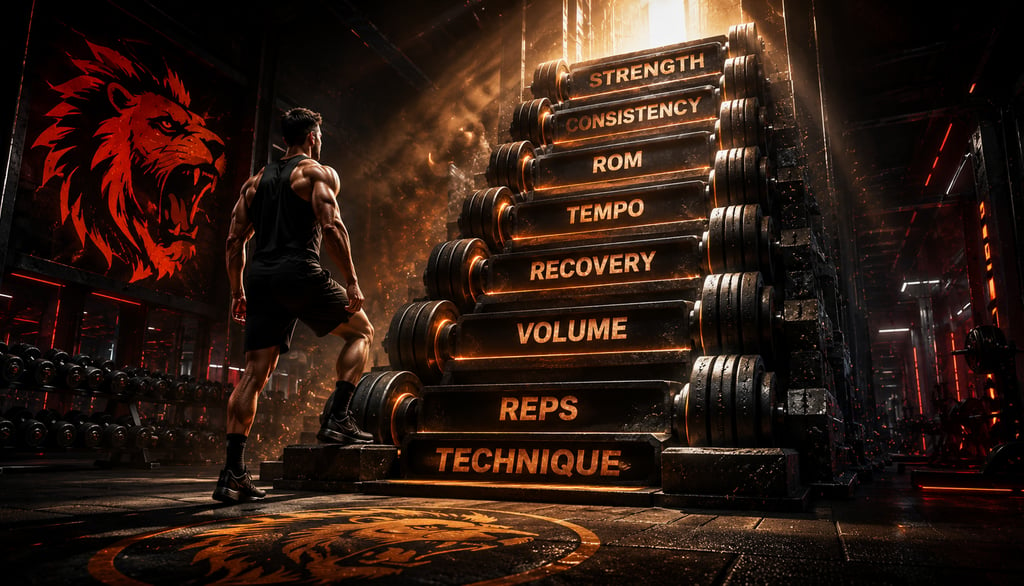
The WazFlex Progressive Overload Pyramid
Think of progressive overload as a pyramid.
Level 1 — Show Up
Nothing works if you aren't consistent.
Level 2 — Recover
Sleep.
Nutrition.
Hydration.
Stress management.
Level 3 — Improve Technique
Move better before moving heavier.
Level 4 — Increase Range of Motion
Earn every repetition.
Level 5 — Increase Repetitions
More quality work.
Level 6 — Increase Weekly Volume
Only when recovery allows.
Level 7 — Increase Load
The final step—not the first.
Notice something?
Adding weight sits near the top—not the bottom.
Because it depends on everything underneath it.
Final WazFlex Message
Progressive overload isn't about chasing heavier weights forever.
It's about becoming a better athlete.
A better mover.
A stronger human being.
Some days you'll add weight.
Other days you'll add a repetition.
Sometimes you'll simply perform the same lift with cleaner technique and greater confidence.
That still counts.
The biggest physiques in history weren't built in one legendary workout.
They were built through thousands of tiny victories, repeated consistently over years.
One extra rep.
One better squat.
One better night's sleep.
One more workout you didn't skip.
That's how champions are built.
And that's how you'll build the strongest version of yourself.
Scientific References
American College of Sports Medicine. Progression Models in Resistance Training for Healthy Adults. Medicine & Science in Sports & Exercise. 2009.
NSCA. Essentials of Strength Training and Conditioning. 4th Edition. Chapters on progressive overload, adaptation, motor learning, exercise progression, recovery, and program design.
Bompa TO, Buzzichelli C. Periodization: Theory and Methodology of Training. Human Kinetics.
Schoenfeld BJ. Science and Development of Muscle Hypertrophy. 2nd Edition. Human Kinetics.
Verkhoshansky Y, Siff MC. Supertraining. Discussion of force production, explosive intent, adaptation, and long-term athletic development.
Suchomel TJ, Nimphius S, Stone MH. The Importance of Muscular Strength in Athletic Performance. Sports Medicine. 2016.
Grgic J, Schoenfeld BJ, et al. Research on training volume, range of motion, and hypertrophy adaptations across different resistance-training variables.
WAZFLEX FITNESS
CONTACT
info@wazflex.com
© 2026. All rights reserved.
PRIVACY POLICY
Train Smart. Build Strong. Stay Real.


The science of strength. The discipline of results.