
Steroids in Gyms: Risks, Fake Trainers & Natural Bodybuilding Truth | WazFlex
Most gym trainers aren’t certified—and some will push steroids for profit. Learn the real risks, science, and why natural training is the smarter path.
MINDSET
Sam Waz
5/4/202611 min read
Training · Integrity · Real Talk
The trainer who tried to sell me drugs — and why it is more common than you think
I have been a natural bodybuilder for years. What happened at the gym that day was not surprising. That is the problem.
I was speaking to someone at the gym , one of the trainers and I was just asking him general questions. As a certified fitness trainer myself, I like to get knowledge from other trainers on various things. I asked him how it was going, because he was preparing for a bodybuilding competition. I just wanted to know how everything was going.
What he said back to me was, to be honest, disgusting.
He told me he was on his cycle right now , taking testosterone and other compounds ,and that bodybuilding is a very expensive sport. And then, without blinking, without lowering his voice, without any apparent awareness of what he was actually saying, he offered to suggest my cycle. Don't worry, no one will ever know you ever took any drugs. No one will ever know you were on a cycle. I know we can do a pretty good PCT.
I stood there and thought about the years I have put into this ,years of natural bodybuilding, years of discipline, years of doing this the hard way because I believe in doing it the hard way. And if I wanted to take steroids, I would have ,along time ago . That is my choice to make as someone who understands what that choice involves. But the casualness of it ,the way this man spoke about injecting synthetic hormones into your body the way someone might recommend a pre-workout — that is what got me. That is what should get everyone.
And let me tell you something else. This guy was not even impressive. He was not built in a way that would make you look twice. You could achieve what he had as an actual natural bodybuilder with a few years of consistent, structured training. He was not a walking advertisement for the product he was selling. He was a walking advertisement for the risk —bloated , not particularly defined, and apparently under the impression that what he had built was worth emulating. That is perhaps the most insulting part of the whole interaction. He wanted to compromise your health for a result you could have earned honestly.
Let us start with the credential problem — because it is worse than you think
Before we go any further, there is something that needs to be said plainly and loudly, because the fitness industry has been too quiet about it for too long.
Most of these trainers are not even certified.
Read that again. The person standing in front of you with a clipboard, a polo shirt with the gym logo on it, and an opinion about your cycle — there is a very real chance they have no formal qualification whatsoever. No accredited certification. No anatomy training. No understanding of physiology, biomechanics, nutrition, or the endocrine system they are casually advising you to chemically manipulate. Nothing. They applied for a job, the gym hired them, and they were handed a client list.
The fitness industry is one of the least regulated professional spaces in existence. In many countries and regions, there is no legal requirement to hold any certification before calling yourself a personal trainer and charging people for advice. Anyone can walk into a gym, get hired, and start telling clients what to inject and when. The barrier to entry is sometimes nothing more than looking the part and being confident enough to charge for it.
A 2019 survey by the International Journal of Exercise Science found significant variation in the quality and rigour of personal training certifications globally — and that a large proportion of practicing trainers either held no recognized qualification or held certifications from unaccredited bodies that required minimal study and no practical assessment. The person advising you on your training may have passed a multiple choice exam they took online over a weekend. The person advising you on your hormone cycle may have no medical training of any kind. Let that sit with you the next time someone with a gym polo shirt tells you what to put in your body.
These are not trainers. They are not coaches. They are not health professionals. They are, at best, enthusiastic amateurs with access to a vulnerable client base. At worst — and this is the category the steroid-pushing ones fall into clearly and without ambiguity — they are drug dealers. That is not a dramatic characterisation. That is a job description. They are sourcing a controlled substance, marking it up, and selling it to people who trust them because of a title they may not have legitimately earned. That is dealing. The gym is just the shopfront.
This is not one trainer. This is a pattern.
I have spoken to many other trainers and they usually ask me the same thing — are you on a cycle? Oh yeah, I was on a cycle earlier. Hey, look at my photos.
And the photos are funny. Because they do not look like someone who is on steroids. They are not that big. They are not that lean. They do not look like someone who has been using pharmaceutical-grade performance enhancing drugs. They look like someone who has been going to the gym fairly regularly and eating reasonably well ,which is exactly what a natural lifter with a couple of years of consistent training looks like. These are people doing drugs, sourcing them from God knows where, administering them without medical supervision, without blood work, without an endocrinologist, without any real understanding of what those compounds are doing inside their bodies at a hormonal and cellular level — and the results are not even remarkable.
That is the part nobody talks about. If the trade-off was health risk in exchange for a genuinely extraordinary physique, at least the equation would be honest. But most of the people casually cycling in commercial gyms are not building extraordinary physiques. They are building slightly above-average physiques while quietly wrecking their cardiovascular system, suppressing their natural hormonal function, and introducing compounds of unknown purity sourced from unregulated markets into their bodies. The return on that investment is not what they were sold. But by the time they figure that out, the trainer has already moved on to the next client.
What steroids actually do to your body — the science they will never tell you
This is the part the casual cycle conversation always skips. The trainer selling you a cycle is not going to sit you down and walk you through the peer-reviewed literature on anabolic steroid use. So here it is — clearly, completely, and without the salesmanship.
Cardiovascular damage — the most serious and least reversible risk
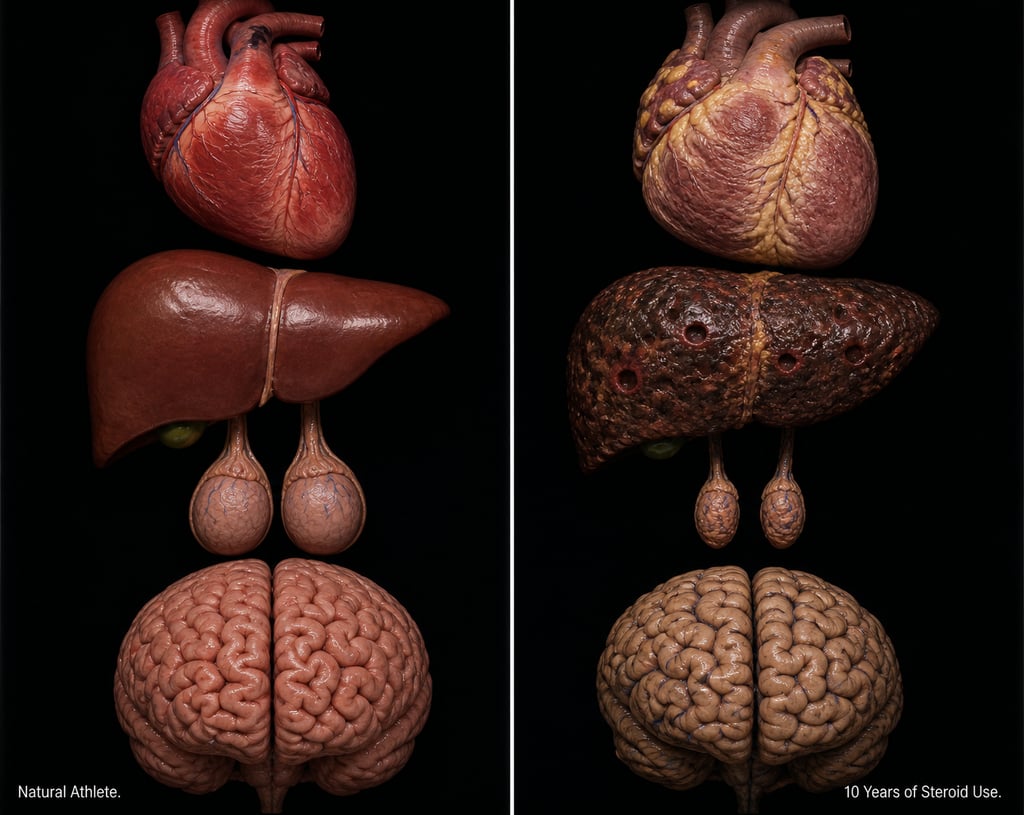
Anabolic steroids cause significant and well-documented cardiovascular damage that begins accumulating from the first cycle and compounds with every subsequent one. Research published in the journal Circulation found that long-term anabolic steroid users had significantly thicker heart muscle walls — a condition called left ventricular hypertrophy — compared to natural athletes of the same age and training volume. This is not strength. This is pathological thickening that impairs the heart's ability to fill and pump blood efficiently — and it dramatically elevates the risk of sudden cardiac death, particularly during intense physical exertion. The same research found that steroid users had dramatically lower levels of HDL cholesterol — the protective kind — and elevated LDL — the arterially damaging kind.
A 2017 study in Arteriosclerosis, Thrombosis, and Vascular Biology found that male steroid users had coronary artery plaque volumes roughly three times higher than non-users of the same age. Three times. At the same age. We are talking about men in their thirties and forties with the arterial health of men in their sixties and seventies — because someone at a gym told them it would be fine and no one would ever know. The arteries know. They have been keeping an honest record since the first injection.
And the deaths — because this needs to be said directly — are real and documented. Numerous high-profile bodybuilders and recreational steroid users have died of cardiac events in their thirties, forties, and fifties. These are not freak occurrences. They are the predictable endpoint of a risk that was taken casually, without full information, often with the encouragement of someone who stood to profit from the decision.
Hormonal devastation — the body stops producing its own testosterone
When you introduce synthetic testosterone into the body, the endocrine system responds by shutting down its own production. The hypothalamic-pituitary-gonadal axis — the hormonal feedback loop that regulates natural testosterone synthesis — detects the artificially elevated levels and signals the testes to stop working. Testicular atrophy is a well-documented, extremely common, and deeply uncomfortable consequence of steroid use. The testes physically shrink from disuse. This is not a rare side effect. It is a predictable physiological response that occurs in virtually every user.
Research published in the Journal of Clinical Endocrinology and Metabolism found that recovery of natural testosterone production after steroid use can take months to years — and in cases of prolonged or heavy use, the suppression can be permanent. The person who told you they can do a pretty good PCT — Post Cycle Therapy — is telling you they have a protocol for attempting to restart a system that was deliberately switched off. PCT works to varying degrees. It does not work perfectly. It does not work predictably. And the longer and heavier the cycle, the less likely it is to restore baseline function fully. Many men who cycled casually in their twenties are on medically prescribed testosterone replacement therapy in their thirties and forties — not by choice, but because their natural production never fully recovered. They traded a decade of natural hormonal function for a physique that faded when the cycle ended.
Liver toxicity — the organ that cannot advocate for itself
Oral anabolic steroids are 17-alpha alkylated — chemically modified to survive the first pass through the liver and enter systemic circulation. This modification is what makes them work orally. It is also what makes them directly toxic to liver tissue. Research consistently shows elevated liver enzymes — AST and ALT — in oral steroid users, indicating active liver cell damage during use. Prolonged use is associated with peliosis hepatis — the formation of blood-filled cysts throughout the liver — and in severe cases, hepatocellular carcinoma, a form of primary liver cancer. The liver cannot tell you it is being damaged. The blood work tells you — but only if someone is running blood work, which the trainer selling you the cycle almost certainly is not. You find out later. Sometimes much later. Sometimes in a hospital.
Psychiatric effects — the psychological cost nobody budgets for
The psychiatric consequences of anabolic steroid use are extensively documented, chronically underreported, and almost never mentioned in the casual conversation that precedes a first cycle. Research published in the Annals of Clinical Psychiatry found significant rates of mood disorders — including major depression, aggression, hypomania, and in severe cases psychotic episodes — in anabolic steroid users. The colloquial "roid rage" is a real clinical phenomenon — elevated androgens directly affect the amygdala, the brain's emotional processing centre, lowering the threshold for aggressive responses to perceived threats or frustrations.
But the more insidious problem is what happens when the cycle ends. Post-cycle hormonal crashes — the period where synthetic testosterone has cleared but natural production has not yet recovered — produce a biological state of hypogonadism. Clinically, this means low testosterone, elevated cortisol, disrupted neurotransmitter function, and the profound, often crushing depression that accompanies it. Cases of suicide in the post-cycle period are documented in the medical literature. This is not a small print warning. This is a known, researched, clinically observed outcome of doing exactly what that trainer casually suggested over a conversation at the gym. He did not mention it because it is not good for sales.
Physical side effects — the ones you will carry permanently
Anabolic steroids dramatically elevate dihydrotestosterone — DHT — a potent androgen directly implicated in male pattern baldness. If you have any genetic predisposition to hair loss, steroids will accelerate it significantly and irreversibly. The hairline that receded at 24 because of a cycle was going to recede eventually — the steroid simply moved the timeline forward by a decade or two, permanently and without refund.
Severe acne — particularly across the back, shoulders, and chest — is extraordinarily common, leaving scarring that persists long after the cycle ends. Gynecomastia — the development of glandular breast tissue in men, caused by the conversion of excess testosterone to oestrogen — is a common consequence that requires surgical intervention to reverse. Stretch marks appear rapidly and permanently as muscle tissue grows faster than the skin can accommodate. These are not temporary inconveniences. They are permanent physical changes to a body that was being managed by someone who was not a doctor, was possibly not even a certified trainer, and was primarily motivated by profit.
The underground sourcing problem — you have no idea what you are actually taking
Here is the part that gets almost no attention and deserves a great deal of it. The steroids being sold casually in gyms by trainers with no medical background are not pharmaceutical-grade compounds from regulated manufacturers. They are sourced from grey market and black market suppliers — underground labs operating without quality control, without sterility standards, and without any obligation to put what they claim to put in the product. Independent testing of underground lab steroid products has found consistent issues with underdosing, overdosing, contamination, and in some cases the presence of entirely different compounds than what was labelled.
You are not just taking a known hormonal risk. You are taking an unknown substance of unverified composition, prepared under unknown conditions, injected into your body by a needle that was hopefully sterile, on the advice of someone who may have no formal training and whose primary interest is the markup between what they paid and what you are paying. The medical risk of anabolic steroids in a controlled, supervised, clinically monitored context is significant. The risk of the same compounds from an underground source administered without medical oversight is considerably higher, less predictable, and being taken on almost entirely by you while the profit goes to someone else.
The research summary — what the science actually concludes
A 2014 meta-analysis in Sports Medicine reviewing the long-term health consequences of anabolic steroid use concluded that cardiovascular, hepatic, endocrine, and psychiatric risks are significant, dose-dependent, and in many cases only partially reversible. The New England Journal of Medicine has published multiple studies linking anabolic steroid use to premature cardiovascular mortality. The British Journal of Sports Medicine has documented the gap between the perceived risk — which users consistently underestimate — and the actual risk, which the clinical literature consistently rates as serious and frequently irreversible.
The trainer who told you no one will ever know did not read any of this. Or he did and decided his commission mattered more than your long-term health. Either way, the information was withheld from you — deliberately or through ignorance — at the moment you most needed it.
What natural training actually builds — and why it is worth infinitely more
The physique built naturally is yours. It belongs to you completely, permanently, without ongoing pharmaceutical maintenance, without quarterly blood work anxiety, without the quiet question of what is happening inside your endocrine system, without the cardiovascular debt accumulating silently in your arteries, without the hormonal dependency, without the hair, without the acne scars, without the gynecomastia consultation.
It is built more slowly. It is harder. It requires patience, consistency, and years of showing up when it would be easier not to. The progress is not dramatic enough to photograph for a transformation post every month. But it compounds. And it stays. Because it was built by a body learning to become stronger — not by a body being temporarily flooded with hormones it did not produce itself and cannot sustain without continuous external supply.
There is no shortcut that does not come with a hidden cost. The people offering you shortcuts are not offering them because they care about your physique. They are offering them because they profit from your impatience and your trust — and they are counting on the fact that the consequences will arrive long after the transaction is complete and they have moved on to the next person.
Ask what the person advising you is qualified to advise you on. And if the conversation turns to cycles, to testosterone, to what nobody will ever find out ,understand clearly what kind of person you are actually talking to. It is not a trainer. It is not a coach. It is a Drug Dealer , It is not someone with your health as their priority.
Do not be fooled.
"A real trainer educates you. A drug dealer with a gym polo shirt sells you a risk you will carry for the rest of your life and calls it a cycle. Know the difference and know that your body is not a quick buck for someone else to make."
Train natural. Train smart. Train for life.
WAZFLEX FITNESS
CONTACT
info@wazflex.com
© 2026. All rights reserved.
PRIVACY POLICY
Train Smart. Build Strong. Stay Real.


The science of strength. The discipline of results.