The Funny Truth About Influencers — Nobody Earned This
Everyone's a celebrity. Nobody has talent. Ad companies don't care and neither does the algorithm. Here's what neuromarketing, fake fame, and boot-licking fan culture are actually doing to your brain — and why the whole thing stinks.
MINDSET
Sam Waz
4/23/20267 min read
# The funny truth about influencers
Nobody asked for this. Somehow we all ended up here anyway.
---
Earlier, if you were famous for something, it was probably because you had talent — or had achieved something in life worth celebrating. Hence the term celebrity. It meant something. It carried weight. It was not handed to you because you figured out how to game a recommendation algorithm. You had to earn it — through years of craft, sacrifice, or genuine achievement that other people could point to and say, that person did something.
I think someone said "In the future, everyone is going to have five minutes of fame."
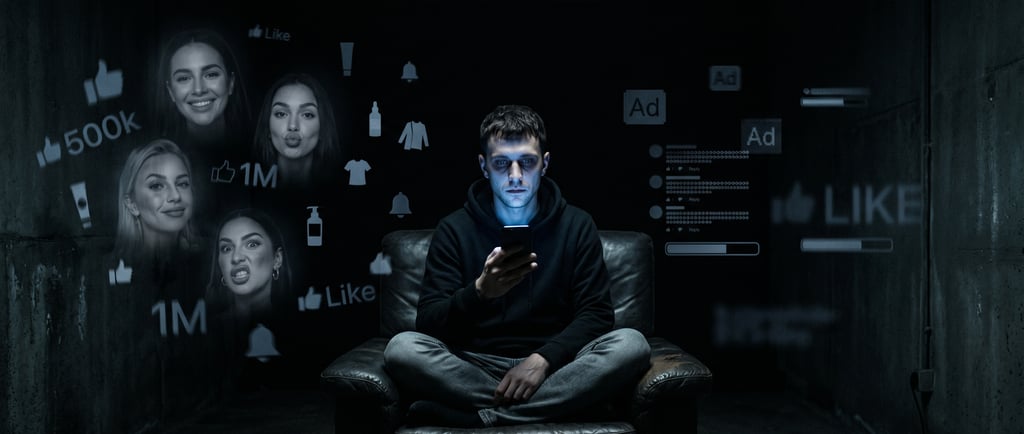
Well. We are living in that future. And it turns out five minutes was an underestimate — because today, everybody is a celebrity in their own head. The problem is they have no talent. No story. No craft. No years of practice. No sacrifice. Nothing that would have qualified them for attention in any previous generation. But ad companies don't mind, as long as you are getting attention. Any attention. The quality of the person is completely irrelevant. The size of the audience is all that matters — and the easiest way to build an audience, it turns out, is not to be good at something. It is to be loud, consistent, and shameless.
Neuromarketing researcher Dr. Robert Cialdini identified the principle of social proof decades ago — the human brain is wired to interpret popularity as a signal of value. If many people are paying attention to something, the brain assumes that thing must be worth paying attention to. The platforms know this. The ad companies know this. The influencer does not need to be talented. They only need to appear popular — and the algorithm will manufacture the appearance of popularity through amplification, recommendation, and the relentless surfacing of whoever is already being watched.
The late night infomercial never left — it just got a ring light
It reminds me of the late night TV ads, where the hosts kept blabbering on about new products, snake oils, bands, and questionable pills with suspiciously enthusiastic testimonials from people who looked like they were reading off a cue card at gunpoint. We all laughed at those. We all knew it was nonsense. The production quality was terrible, the claims were absurd, and the whole thing had the unmistakable smell of desperation and deceit.
Nobody is laughing now — because the same exact thing is happening on every platform, every day, in every feed, dressed up in better lighting and a more relatable caption. The snake oil is still snake oil. The pill is still questionable. The only thing that changed is the host has a ring light, a skincare routine, and calls themselves a content creator.
The science behind why this works on people is genuinely disturbing. Neuromarketing studies using fMRI brain imaging have shown that when consumers watch someone they perceive as relatable — not a polished celebrity, but an ordinary-looking person in a bedroom or kitchen — the brain's medial prefrontal cortex activates more strongly. This is the region associated with self-referential thinking. In plain language, the brain starts mapping the influencer's life onto its own. It stops processing what it is watching as an advertisement and starts processing it as a peer recommendation. The informercial felt like an ad. The influencer feels like a friend. That is not accidental. That is engineered.
I see the dumbest things going on — and you cannot say anything about it or else you will be banned. Flagged. Shadowbanned. Reported by the very audience that is being sold to. That is the part that should terrify people. The consumer has become the enforcer of the con. They are defending the people who are extracting money from them, because criticising the influencer feels — neurologically — like criticising a friend. And the brain does not like that.
Where did the stories go
I had to quit my personal social media. Because that is all it is — underdeveloped brains with below average faces trying to sell you something that you do not actually give a damn about.
Where did the stories go? Where did the entertainment go? Where did the craft go — the people who actually had something to say, something to show, something to offer beyond a discount code and a pouty expression? Why am I now obliged to look at these ugly mugs and agree? Why has the bar dropped so far below the floor that we have stopped noticing it is underground?
There was a time when fame was a byproduct of something real. An actor who moved you. A musician whose songs meant something. An athlete whose performance was genuinely extraordinary. A writer who put words together in a way that made you feel less alone. These people existed. Some of them still do. But they are increasingly buried under an avalanche of people whose only demonstrable skill is the ability to film themselves and press upload — and who have been algorithmically elevated above people with genuine craft because the algorithm does not reward quality. It rewards watch time. It rewards the neurological hook, the dopamine spike, the scroll-stopping thumbnail. Quality is not a ranking factor. Compulsiveness is.
Dr. BJ Fogg of Stanford's Behaviour Design Lab spent years studying how technology companies design for habit. His conclusion was unambiguous — these platforms are not neutral tools. They are behaviour change systems, built by teams of engineers whose job is to make leaving as neurologically costly as possible. Every notification, every autoplay, every infinite scroll is a friction-removal mechanism designed to keep the brain in a passive consumption loop. The stories did not go anywhere. The architecture of the platform was redesigned to make stories less profitable than reaction content — because reaction is faster, cheaper, and more addictive. The craft was not killed by the audience. It was deprioritised by the machine.
The fan culture problem — and it is nauseating
And then there is the boot-licking, the shit-eating, the ass-kissing fan culture — and I say this with complete sincerity — it is nauseating to look at. Grown adults. Proper full-grown adults with jobs and mortgages and children acting like slaves to celebrities, politicians, sports players, glorified porn stars. The list goes on.
Defending people who do not know they exist. Going to war in comment sections over the honour of someone who has never thought about them once. Spending real money — money earned at a real job, with real hours, from a real life — on merchandise, on subscriptions, on tokens of loyalty to people who are performing for profit. You are not the fan. You are the revenue stream. There is a difference — and the people you are defending know which one you are, even if you do not.
The neuroscience behind parasocial relationships — the one-sided emotional bonds between fans and public figures — is well documented and frankly unsettling. Research published in the Journal of Consumer Psychology found that parasocial relationships activate the same neural pathways as real social relationships. The brain does not reliably distinguish between a genuine friendship and a relationship conducted entirely through a screen. The grief people feel when a celebrity they have never met dies is neurologically real. The outrage they feel when that celebrity is criticised is neurologically real. The compulsion to defend, to donate, to buy — all of it is being driven by brain processes that evolved to manage real human relationships and are being systematically exploited by the attention economy.
And no one is trying to save the poor. No one is trying to make this planet a better place. The platforms are not optimized for empathy or progress or genuine human connection. They are optimized for engagement — which turns out to look a lot like outrage, obsession, and the kind of tribalism that keeps people clicking without ever moving. A 2020 study from MIT found that false information spreads six times faster than true information on social media — because false information is more emotionally arousing, and emotional arousal drives sharing. The platform is not interested in what is true. It is interested in what spreads. And what spreads fastest is the content that makes people feel the most — usually anger, fear, or tribal loyalty to someone they have never met.
My question to those still awake — what the f* is going on?
Because something has gone very wrong. And the fact that pointing it out gets you banned, reported, or labelled a hater tells you everything you need to know about how deeply the problem runs. The criticism of the system is not welcome inside the system. That has always been the sign that the system is working exactly as intended — just not for you.
The attention economy is not broken. It is doing precisely what it was built to do. It is farming human attention, packaging it, and selling it to advertisers at scale — using influencers, talented or otherwise, as the mechanism of extraction. The influencer is not the beneficiary in the way they think they are. The influencer is the bait. The audience is the catch. And the advertiser is the one who actually profits from the transaction. Everyone else is performing for a cut that gets smaller the more people compete for it.
Dr. George Loewenstein, a behavioural economist at Carnegie Mellon, identified what he called the information gap theory of curiosity — the brain experiences an almost physical discomfort when it senses a gap between what it knows and what it could know. This is why thumbnails say "you won't believe what happened" and videos are titled with questions that are never fully answered. The brain is not being entertained. It is being put in a state of mild neurological distress and then strung along just enough to keep it watching. That is not content. That is a manipulation loop. And most people are sitting inside one for several hours every day without realising it.
You are allowed to opt out. In fact, opting out might be the most radical act available to a person right now. Put down the feed. Find something real. Build something. Make something. Say something that is genuinely yours — not for an audience, not for an algorithm, not for five minutes of fame that dissolves the moment the next thing trends.
Fame used to mean something. Let us stop pretending it still does — and let us stop performing for the people who need us to keep pretending.
---
"Everybody is a celebrity in their own head. The problem is they have no talent — and the tragedy is we keep watching anyway."
Do something real
The antidote to a culture that rewards performance over substance is to build something real — starting with yourself. At Wazflex, we work with people who have stopped outsourcing their identity to a screen and started investing it in their body, their health, and their discipline. The gym does not care how many followers you have. The bar does not care what your engagement rate is. Results here are earned — and they belong to you in a way that no amount of likes ever will. If you are ready to do something that actually compounds and is genuinely yours ,join us today and book your appointment now .
WAZFLEX FITNESS
CONTACT
info@wazflex.com
© 2026. All rights reserved.
PRIVACY POLICY
Train Smart. Build Strong. Stay Real.


The science of strength. The discipline of results.