
Training Frequency: Is Once, Twice, or Three Times Per Week Best?
Is training a muscle once, twice, or three times per week best? Discover what science says about training frequency, recovery, and maximizing muscle growth.
WORKOUT PROGRAMS
Sam Waz
7/16/20266 min read
Training Frequency: Is Once, Twice, or Three Times Per Week Best?
Walk into almost any gym and you'll hear strong opinions.
One bodybuilder swears by "Chest Monday."
Another insists every muscle must be trained twice a week.
A hybrid athlete tells you to train everything three times a week.
Then someone on Instagram claims that if you're not hitting each muscle every 48 hours, you're wasting your membership.
So who's right?
The answer may surprise you.
All of them can be.
And all of them can also be wrong.
Because the question isn't:
"How often should I train a muscle?"
The real question is:
"How often can I train a muscle while still recovering, progressing, and getting stronger?"
That single shift in thinking changes everything.
Your Muscles Don't Own Calendars
Your chest doesn't know it's Monday.
Your legs don't know it's Friday.
Your biceps don't know you've decided Wednesday is "Arm Day."
Muscles don't recover according to the calendar.
They recover according to the stress you've placed on them.
Every workout creates three things:
• Muscle damage
• Fatigue
• Adaptation
The goal isn't simply to recover.
The goal is to recover and become better prepared for the next training session.
Train too soon and performance drops.
Wait too long and you may miss opportunities to stimulate growth again.
Finding that balance is what training frequency is all about.
The Biggest Myth in Bodybuilding
There was a time when nearly every bodybuilding magazine recommended this split.
Monday
Chest
Tuesday
Back
Wednesday
Shoulders
Thursday
Legs
Friday
Arms
Saturday
Rest
Sunday
Rest
This approach built incredible physiques.
It also created one of the biggest myths in fitness.
People assumed:
Professional bodybuilders train each muscle once per week. Therefore once per week must be optimal.
But that's missing important context.
Professional bodybuilders often:
• Train with enormous volume
• Have years of experience
• Recover differently
• Structure workouts around extremely high per-session volume
• Sometimes use performance-enhancing drugs
That doesn't automatically make a once-per-week split the best choice for a natural lifter training after work.
Frequency Is Not the King—Volume Is
Here's something many people don't realize.
Imagine these two lifters.
Person A
Trains chest:
20 sets
Once per week
Person B
Trains chest:
10 sets Monday
10 sets Thursday
Total:
20 weekly sets.
Who will build more muscle?
According to current evidence...
Probably neither.
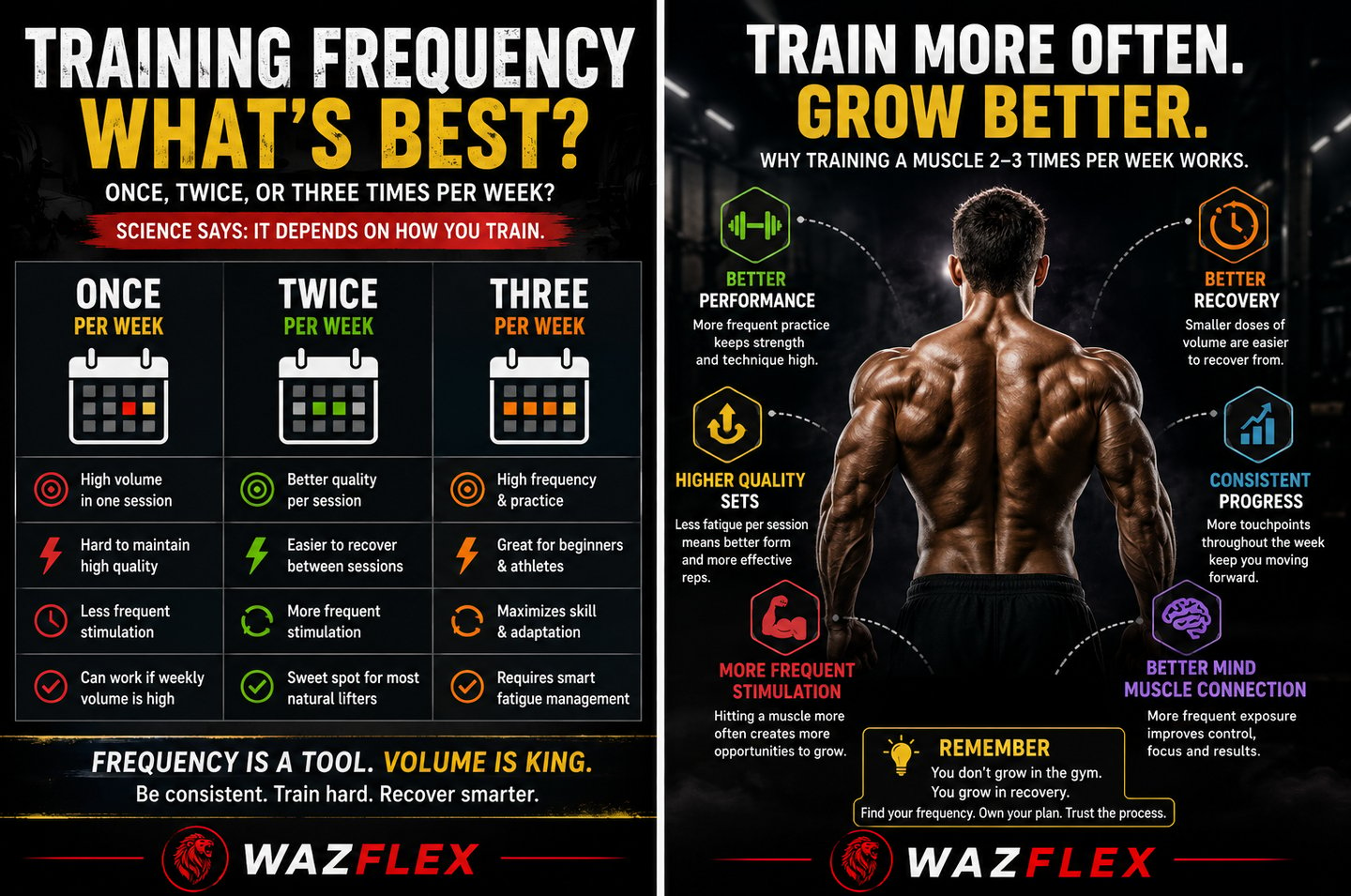
When total weekly training volume is equated, training a muscle once or twice per week generally produces similar hypertrophy outcomes in many studies.
The difference isn't frequency itself.
It's what frequency allows you to do.
This is one of the key conclusions discussed across modern hypertrophy literature and is reflected in your uploaded training resources, where weekly training volume is presented as the primary driver while frequency is largely a tool for distributing that volume effectively.
That sentence alone destroys years of gym arguments.
Frequency isn't magic.
It's a tool.
So Why Does Everyone Recommend Training Twice Per Week?
Because life isn't a laboratory.
Let's go back to our example.
Twenty chest sets.
All on Monday.
How do your last six sets look?
You're tired.
Your pressing strength has dropped.
Your pump is incredible.
Your technique?
Not so much.
Now split those same twenty sets across Monday and Thursday.
Suddenly:
You're fresher.
You're stronger.
You can lift more weight.
You perform better.
Your technique stays cleaner.
Your quality stays higher.
That's the real advantage.
Frequency allows you to maintain quality.
Not necessarily create magic.
The Muscle & Strength Training Pyramid discusses frequency primarily as a way to distribute productive volume and manage fatigue rather than as an independent driver of muscle growth.
Once Per Week Can Work
This might surprise people.
Yes.
Training a muscle once per week can absolutely build muscle.
Especially if:
• Weekly volume is sufficient
• Intensity is appropriate
• Progressive overload occurs
• Recovery is excellent
Many successful bodybuilders have built incredible physiques using traditional bro splits.
But here's the catch.
A bro split gives you exactly one opportunity every seven days.
If Monday's chest workout goes badly...
You've lost an entire week.
Miss leg day?
See you next Thursday.
That lack of flexibility becomes a disadvantage for many natural lifters.
Twice Per Week: The Sweet Spot for Most People
If there were one frequency I'd recommend to the majority of WazFlex readers...
It's this.
Twice per week.
Why?
Because it balances everything.
Recovery.
Performance.
Volume.
Consistency.
Lifestyle.
Instead of trying to destroy a muscle in one marathon workout...
You stimulate it.
Recover.
Stimulate it again.
For example:
Monday
Chest + Shoulders
Thursday
Chest + Triceps
Each session stays shorter.
Performance stays higher.
Recovery stays manageable.
For most natural lifters, this is an excellent long-term strategy.
Can Three Times Per Week Be Better?
Sometimes.
Especially for:
Beginners
Athletes
Hybrid athletes
Strength-focused lifters
People using full-body programs
Imagine training your back.
Monday
4 sets
Wednesday
4 sets
Friday
4 sets
Instead of:
12 brutal sets on Monday.
Every session feels fresh.
You practice movement more frequently.
Technique improves faster.
Beginners especially benefit because strength is also a skill.
The more often they perform good-quality repetitions...
The faster they usually improve.
Why Beginners Should Train More Frequently
This sounds backwards.
Most beginners think they need less training.
Actually...
They often benefit from more frequent but shorter sessions.
Why?
Because they don't need enormous volume.
They need repetition.
Learning to squat.
Learning to bench.
Learning to row.
Learning to brace.
Motor learning improves through quality practice.
Not one gigantic workout followed by six days off.
Advanced Lifters May Train Less Often—Or More Often
Experience changes everything.
Advanced lifters generate much larger training stimuli.
A beginner might squat 40 kg.
An advanced lifter squats 220 kg.
Those aren't remotely the same stress.
The stronger you become...
The harder recovery becomes.
Some advanced lifters therefore perform:
One extremely hard leg session.
Others divide that workload across two or even three sessions.
Neither approach is automatically superior.
It depends on:
Recovery
Lifestyle
Goals
Weekly volume
Exercise selection
Sleep
Nutrition
Frequency Doesn't Fix Bad Programming
This is where social media gets it wrong.
People ask:
"Should I train chest three times a week?"
Wrong question.
If your program is terrible...
Training it three times per week simply means you're repeating terrible programming more often.
Frequency cannot fix:
Poor exercise selection
Lack of progressive overload
Poor sleep
Low protein
Too little volume
Too much junk volume
Terrible technique
Frequency amplifies your program.
It doesn't rescue it.
The Biggest Mistake: Destroying a Muscle Every Session
Many lifters think:
"If I'm training chest twice a week...
I need to absolutely destroy it twice a week."
No.
Remember our previous article.
Stimulus versus fatigue.
The goal isn't annihilation.
It's adaptation.
Train hard.
Recover.
Repeat.
The people making the best progress usually leave the gym feeling like they could come back tomorrow if they had to.
Not like they've survived a car crash.
A Simple Guide for Most Lifters
Beginners
2–3 times per week
Full body
Focus on technique.
Intermediate
2 times per week
Upper/Lower
Push/Pull/Legs
Upper/Lower
Excellent balance.
Advanced
1–3 times per week
Depends on:
Volume
Recovery
Goals
Weak points
Programming
There is no universal answer.
What About Recovery?
This is where frequency becomes personal.
If you're:
Sleeping 5 hours
Working 70-hour weeks
Eating very little protein
Constantly stressed
Training six days per week may not be intelligent.
Recovery determines frequency.
Not motivation.
Your muscles don't care how motivated you are.
They care whether they've recovered enough to perform again.
The WazFlex Rule
Ask yourself one question.
Can I train this muscle today with equal or better performance than last time?
If yes...
You're probably recovered.
If performance keeps falling...
You're probably accumulating fatigue faster than you're recovering.
Listen to performance.
Not the calendar.
The Verdict
So...
Once?
Twice?
Three times?
The answer is:
It depends.
But here's what current evidence and decades of practical coaching suggest.
Once per week
✓ Can build muscle
✓ Works well with high-volume splits
Twice per week
✓ Best balance for most natural lifters
✓ Excellent recovery
✓ High-quality sessions
✓ Easier progression
Three times per week
✓ Excellent for beginners
✓ Great for athletes
✓ Fantastic for skill development
✓ Requires intelligent fatigue management
Final WazFlex Message
The fitness industry loves arguing about frequency.
Once.
Twice.
Three times.
The truth?
Frequency isn't the secret.
Quality is.
A perfectly designed program performed twice a week will outperform a terrible program performed three times a week.
A lifter who sleeps well, eats enough protein, progressively overloads and trains consistently once or twice per week will almost always outperform someone training six days a week without a plan.
Stop asking:
"How often should I train?"
Start asking:
"How often can I recover, improve, and come back stronger?"
That's the question elite athletes ask.
And that's the question that builds elite physiques.
Scientific References
Schoenfeld BJ, Ogborn D, Krieger JW. Effects of Resistance Training Frequency on Measures of Muscle Hypertrophy: A Systematic Review and Meta-Analysis. Sports Medicine. 2016.
Grgic J, Schoenfeld BJ, et al. Effects of Resistance Training Frequency on Gains in Muscular Strength: A Systematic Review and Meta-Analysis. Sports Medicine. 2018.
American College of Sports Medicine. Progression Models in Resistance Training for Healthy Adults. Medicine & Science in Sports & Exercise. 2009.
Helms E, Morgan A, Valdez A. The Muscle & Strength Training Pyramid: Training. Discussion of training frequency as a method of distributing weekly volume and managing fatigue.
NSCA. Essentials of Strength Training and Conditioning. 4th Edition. Chapters covering frequency, adaptation, periodization, and recovery.
WAZFLEX FITNESS
CONTACT
info@wazflex.com
© 2026. All rights reserved.
PRIVACY POLICY
Train Smart. Build Strong. Stay Real.


The science of strength. The discipline of results.