
What Happened to the Cool Girls? The Baddie Trap That's Ageing Women Fast
Every generation has them — glamorous, untouchable, living like a movie. But smoking, drinking, drugs and borrowed aesthetics have a price. Here's what the science says, what the cool girls became, and why staying fit, eating clean and choosing yourself is the only flex that lasts.
MINDSET
4/11/20267 min read
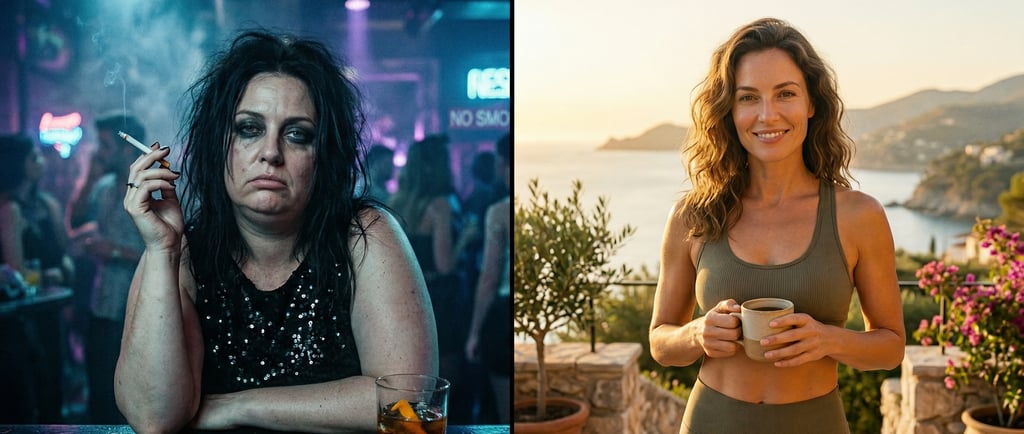
What happened to the cool girls?
Every generation has them. Every generation watches them fade. Here's why — and how to make sure you're not next.
You know who I'm talking about. Every generation has them — the cool girls. The ones who seemed to have it all. Glamorous. Effortless. The ones who made smoking look cinematic, drinking look like a personality, and a drug habit look like an edgy phase worth documenting.
They wanted to marry rich. They wanted to be famous. They dreamed of being the actress, the model, the singer. They studied their favourite celebrities like scripture — the outfits, the attitude, the aesthetic. Their whole life felt like a movie, and they were convinced they were the lead.
These days, they call themselves baddies. The word changes. The trap doesn't.
"The only thing bad about the baddie is her bad breath and body odour."
The predecessor nobody talks about
Here's what the current generation of baddies doesn't know — or chooses not to look at. The ones before them couldn't keep up. The lifestyle was loud, but the consequences were louder. The bad habits stuck around long after the pretty looks packed their bags and left.
Catch them now? You'll find them reminiscing. Talking about how they were a beauty queen back in the day. How they had it. And what remains? A sagging face. Stained teeth. An unhealthy body. Dreams that stayed exactly where they were — dreams.
Why women are most vulnerable to the celebrity trap
The beauty and celebrity industry is built on selling women an image — and then selling them the products to chase it. Women are conditioned from a young age to perform, to be seen, to be desired. The pressure is real, constant, and it starts early.
Celebrity culture makes destruction look polished. The cigarette in the editorial shoot. The cocktails on the yacht. The pill at the after-party that nobody films but everybody knows about. The "effortless" body that apparently requires zero maintenance. It is all a lie dressed in a designer outfit — and women are the primary market for that lie.
The celebrity has a team. A trainer, a chef, a dermatologist, a therapist, an editor, and a very good filter. You have Tuesday morning and a bad habit. It is not the same thing. It will never be the same thing.
Smoking — the most glamorised act of self-destruction
Smoking is possibly the single worst thing a person can do to themselves — full stop. For women specifically, the damage is relentless and visible. Cigarette smoke breaks down collagen and elastin — the proteins responsible for keeping skin firm and youthful. Research published in Plastic and Reconstructive Surgery found that smokers show significantly more facial ageing than non-smokers of the same age, with deeper wrinkles, duller skin tone, and accelerated sagging around the jaw and eyes.
Beyond the face — smoking attacks lung capacity, disrupts hormonal balance, reduces fertility, and dramatically elevates cancer risk. Stained teeth. Persistent bad breath that no mint fixes. Skin so dull no filter fully saves it. The aesthetic lasts a moment. The damage lasts decades.
Alcohol — the slow thief
Alcohol has been sold to women as sophistication — the wine glass, the brunch cocktail, the girls' night ritual. But the science doesn't care about the aesthetic. Alcohol is a known carcinogen. It dehydrates the skin, disrupts sleep quality, spikes cortisol levels, and accelerates visible ageing. Research in the British Journal of Dermatology linked regular alcohol consumption directly to increased facial puffiness, broken capillaries, and loss of skin elasticity — especially in women, who metabolise alcohol differently and feel its effects at lower quantities than men.
Chronic drinking goes after the liver, disrupts hormones, fuels weight gain, and chips away at mental health. The woman who thought she was living the life at 25 is fighting inflammation, anxiety, and a metabolism in revolt at 35. The cocktail was not the flex. It was the cost.
Drugs — the fastest route to nowhere
Recreational drug use has been normalised in party culture and increasingly romanticised on social media — the festival, the after-party, the "living in the moment" narrative. But the body keeps the score, always. Stimulants like cocaine and MDMA cause severe vascular constriction, deplete serotonin reserves, and put the cardiovascular system under enormous stress. For women, the consequences extend further — disrupted cycles, accelerated bone density loss, and heightened vulnerability to anxiety and depression long after the substance has cleared the body.
The American Society of Addiction Medicine has documented that women develop substance dependencies faster than men, experience more severe health consequences at lower usage levels, and face greater barriers to recovery. The party phase ends. The damage it leaves behind does not come with a checkout time.
The cool girl at the party becomes the cautionary tale nobody posts about. Sunken cheeks. Erratic weight. Teeth that tell on her before she opens her mouth. The glamour was borrowed. The consequences are permanent.
Why the gym is the most powerful anti-ageing tool a woman has
No serum, no treatment, no procedure comes close to what consistent exercise does to the female body over time. This is not opinion — it is one of the most well-documented findings in modern health science. A landmark study published in Preventive Medicine found that highly active women had cells biologically nine years younger than their sedentary peers at the same chronological age. Nine years. That is not a supplement. That is not a clinic visit. That is showing up and moving your body.
Here is what regular training actually does — in detail:
Skin & collagen
Exercise increases blood circulation, delivering oxygen and nutrients directly to skin cells while flushing out toxins. A study from McMaster University found that endurance exercise promotes the production of a compound that reverses skin ageing at a structural level — the skin of active women in their 40s was found to resemble the composition of women in their 20s and 30s. Strength training specifically stimulates collagen synthesis, reducing the formation of fine lines and maintaining skin firmness over time.
Bone density & joint health
Women begin losing bone density from their 30s, accelerating sharply after menopause. This is not optional biology — it happens to every woman. What can be controlled is how much muscle and bone mass she preserves going in. Weight-bearing exercise and resistance training are the most effective non-pharmaceutical interventions for maintaining bone density, reducing osteoporosis risk, and protecting joint integrity. The National Osteoporosis Foundation states that women who train regularly throughout their lives maintain significantly stronger skeletal structures into old age.
Hormonal balance
Regular exercise regulates oestrogen and progesterone levels, reduces excess cortisol, and stabilises insulin sensitivity. For women, this translates to more consistent energy, reduced PMS symptoms, better mood regulation, and a lower risk of conditions like PCOS and type 2 diabetes. The hormonal environment created by a fit, active lifestyle is one of the most powerful forms of internal anti-ageing available — it keeps the body functioning the way it was designed to.
Mental health & brain function
Exercise is one of the most clinically effective treatments for anxiety and depression — rivalling antidepressants in mild to moderate cases according to research in JAMA Psychiatry. It triggers the release of BDNF (brain-derived neurotrophic factor), a protein that supports the growth of new brain cells and protects against cognitive decline. Women who exercise regularly report sharper focus, stronger memory, and greater emotional resilience well into their later decades. Confidence is not something you buy. It is something you build — rep by rep.
Metabolism & body composition
Muscle is metabolically active tissue — it burns calories even at rest. Women who build and maintain lean muscle mass through resistance training have a significantly higher resting metabolic rate, making it easier to maintain a healthy body weight as they age. Without training, women lose an average of 3–8% of their muscle mass per decade after 30. This is not inevitable deterioration — it is preventable with consistent work in the gym.
Cardiovascular health & longevity
Heart disease is the leading cause of death in women globally — not cancer, not accidents. Regular cardio exercise strengthens the heart muscle, lowers blood pressure, reduces LDL cholesterol, and improves circulatory efficiency. The American Heart Association found that women who meet recommended weekly exercise targets reduce their risk of cardiovascular disease by up to 35%. More than any supplement or skincare routine, a healthy heart is what keeps you looking and feeling alive.
Eat clean — because your skin is a mirror
You cannot out-train a bad diet, and you cannot fake what a good one gives you. An anti-inflammatory diet rich in whole foods, lean protein, healthy fats, and antioxidants directly supports collagen production, hormonal balance, gut health, and stable energy. Research from the Nutrients Journal links consistent clean eating in women to reduced chronic disease risk, clearer skin, lower rates of depression, and significantly better long-term body composition.
Foods rich in vitamin C — berries, citrus, leafy greens — directly stimulate collagen synthesis. Omega-3 fatty acids from oily fish and nuts reduce systemic inflammation that accelerates ageing at a cellular level. Protein supports muscle repair and keeps skin tissue dense and resilient. Water keeps everything working. It really is that direct — what goes in shows up on the outside.
The processed food, the excess sugar, the constant takeaways — they spike inflammation, disrupt hormones, accelerate glycation (a process that literally stiffens and ages skin tissue), and drain your energy. You cannot look healthy if you are not feeding your body the materials to build health with. It is that simple and that non-negotiable.
The other side — what good habits actually build
Here is the thing nobody glamourises enough — the woman who chose differently. She's not trending. She's not in the club at 2am. She's at the gym, she's drinking her water, she's sleeping her eight hours, she's eating food that serves her. And at 45, she looks like what the baddie was trying to fake at 22.
Good habits compound exactly the same way bad ones do. Every workout, every clean meal, every early night, every glass of water — they stack quietly, consistently, invisibly at first. And then one day you're 40, and people ask what your secret is. There is no secret. There was just discipline on the days it felt boring, while everyone else was still recovering from Saturday night.
The women who age like something rare didn't stumble into it. They chose it — repeatedly, in moments that felt the least glamorous. That is the real flex. Not the pose. Not the filter. The discipline.
Final word
"So if you're one of the good girls, be proud of yourself — because the only thing a baddie will soon have is a bad breath and a bad body odour."
Start somewhere
Every woman who is thriving physically started from the same place — the decision to begin. Not a perfect plan. Not the right moment. Just a decision. You're already here, which means part of you is ready. Let Wazflex take it from there — personalised online coaching, real structure, and workouts built around your body and your goals. No guesswork. No overwhelm. Just the work, and the results that come with it. Book your appointment today and let this be the first good habit you build.
WAZFLEX FITNESS
CONTACT
info@wazflex.com
© 2026. All rights reserved.
PRIVACY POLICY
Train Smart. Build Strong. Stay Real.


The science of strength. The discipline of results.